Inverse Laplace transform - using the table
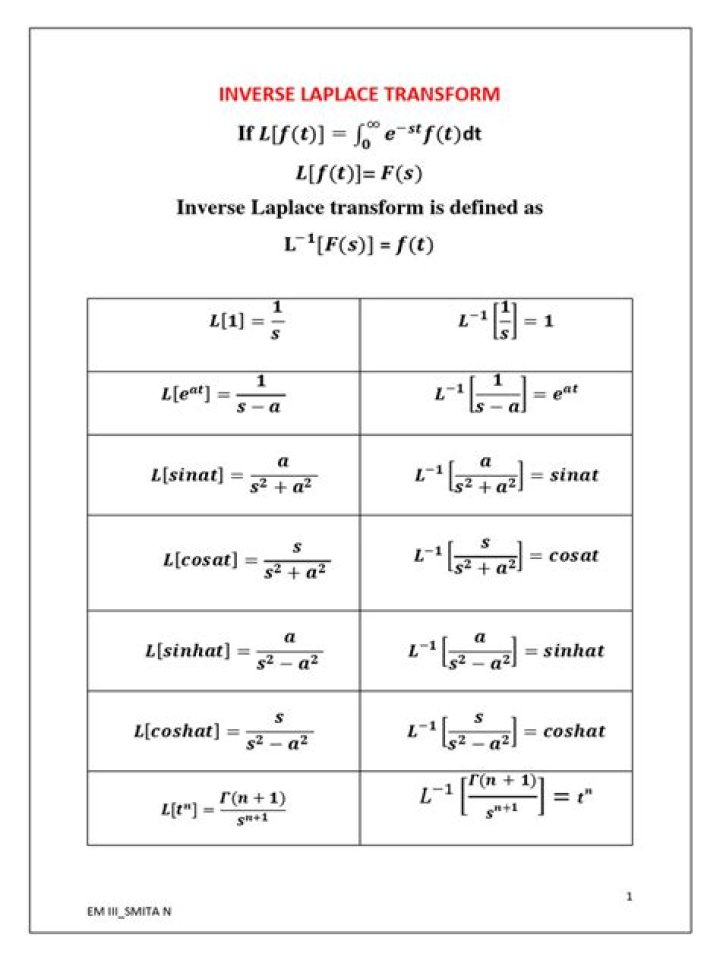
I am trying to find the inverse Laplace transform $(g(t))$ of
$$ G(s) = \frac{2s}{(s+1)^2+4}$$
I know about the inverse transforms $e^{a t}\cos(\omega t)$ and $\mathrm{e}^{at}\sin(\omega t)$ however I am trying to get the inverse transforms without these, as these are not on the table of standard transforms for our course.
I was also attempting to use $\mathrm{e}^{at} f(t) \leftrightarrow F(s-a)$, but I'm not sure how to go about this, either.
Any help would be appreciated. :)
$\endgroup$ 52 Answers
$\begingroup$If you have $(s+1)^2$ in the denominator then make it appear in the numerator by adding zero:
$$ G(s) = \frac{2s}{(s+1)^2+4} = \frac{2(s+1-1)}{(s+1)^2+4} = 2 \frac{s+1}{(s+1)^2+4}-\frac{2}{(s+1)^2+4} $$
$\endgroup$ $\begingroup$The inverse Laplace transform is defined by,
$$ f(x) = \frac{1}{2\pi i}\int_C F(s) {\rm e}^{sx} ds \,$$
where $F(s)$ is the Laplace transform of $f(x)$, and $C$ is the Bromwich contour.
$$ f(x) = \frac{1}{2\pi i} \int_C \frac{{2s\,\rm e}^{sx}}{((s+1)^2+4)} ds = \frac{1}{2\pi i} \int_C \frac{{2s\,\rm e}^{sx}}{(s^2+2s+5)} ds $$
$$= \frac{1}{2 \pi i} \int_C \frac{{2s\,\rm e}^{sx}}{(s+1+2i)(s+1-2i)} ds\,.$$
The integrand has two simple poles at $s=-(1+2i)$ and $ s=-1+2i $ which implies,
$$ f(x) = \lim_{s\rightarrow -(1+2i)} \frac{{2s\,\rm e}^{sx}}{(s+1-2i)} + \lim_{s\rightarrow (-1+2i)} \frac{{2s\,\rm e}^{sx}}{(s+1+2i)} $$
$$ = {{\rm e}^{-x}} \left( 2\,\cos \left( 2\,x \right) -\sin \left( 2\,x \right) \right) $$
$\endgroup$