Intuitive understanding of the derivatives of $\sin x$ and $\cos x$
One of the first things ever taught in a differential calculus class:
- The derivative of $\sin x$ is $\cos x$.
- The derivative of $\cos x$ is $-\sin x$.
This leads to a rather neat (and convenient?) chain of derivatives:
sin(x)
cos(x)
-sin(x)
-cos(x)
sin(x)
...
An analysis of the shape of their graphs confirms some points; for example, when $\sin x$ is at a maximum, $\cos x$ is zero and moving downwards; when $\cos x$ is at a maximum, $\sin x$ is zero and moving upwards. But these "matching points" only work for multiples of $\pi/4$.
Let us move back towards the original definition(s) of sine and cosine:
At the most basic level, $\sin x$ is defined as -- for a right triangle with internal angle $x$ -- the length of the side opposite of the angle divided by the hypotenuse of the triangle.
To generalize this to the domain of all real numbers, $\sin x$ was then defined as the Y-coordinate of a point on the unit circle that is an angle $x$ from the positive X-axis.
The definition of $\cos x$ was then made the same way, but with adj/hyp and the X-coordinate, as we all know.
Is there anything about this basic definition that allows someone to look at these definitions, alone, and think, "Hey, the derivative of the sine function with respect to angle is the cosine function!"
That is, from the unit circle definition alone. Or, even more amazingly, the right triangle definition alone. Ignoring graphical analysis of their plot.
In essence, I am asking, essentially, "Intuitively why is the derivative of the sine the cosine?"
$\endgroup$ 1317 Answers
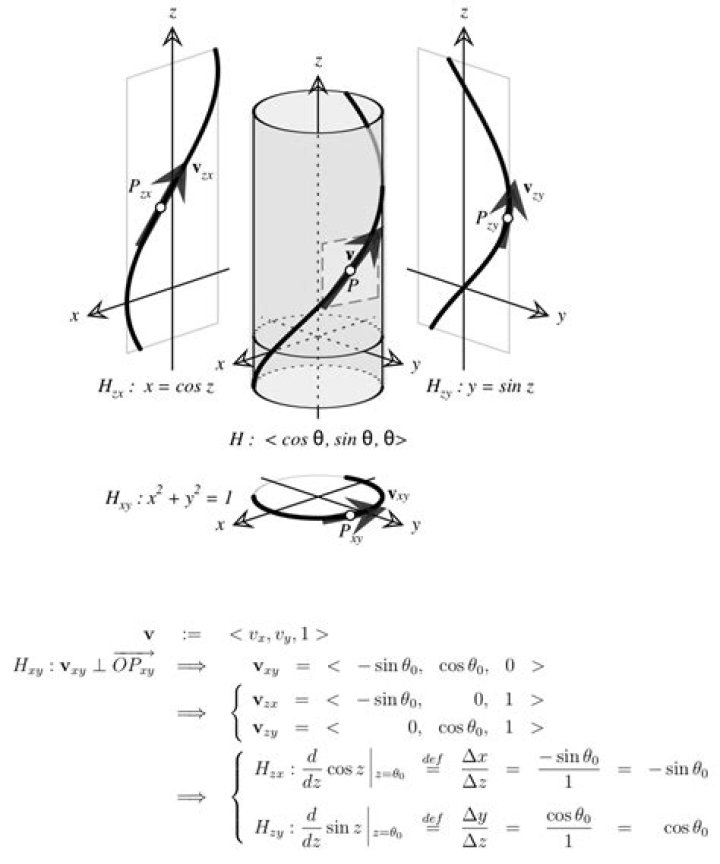
$\begingroup$Perhaps the following diagram will provide insight:
The idea is to look at the sine and cosine curves as projections of a helix drawn on a cylinder. If you look at the cylinder itself as a curled planar square of length $2\pi$, then helix is a curled version of the square's diagonal. A tangent vector along the flat square's diagonal always lies at 45 degrees to the square's sides, say with length-"1" shadows in each direction; after smoothly curling the square into the cylinder, the tangent vector lies at 45 degrees to the cylinder's ($z$-)axis and the perpendicular ($xy$-)plane.
Projecting the helix into the $zy$- and $zx$-planes gives graphs of sine and cosine. Projecting the helix's tangent vector gives tangent vectors to those graphs. The "$\mathrm dz$"s for these projected tangents are always $1$ (the "vertical" shadow of the helix's tangent vector). To get at "$\mathrm dy$" and "$\mathrm dx$" ("$v_x$" and "$v_y$" in the diagram) we project down into the $xy$-plane where we see a circle, and yet another projected tangent vector.
Basic geometry tells us that a tangent to a circle is perpendicular to the radius at the point of tangency. In our circle, the point of tangency --and the radius vector it-- is parameterized as "$<\cos$, $\sin$, $0>$". The perpendicular tangent line must therefore have a "negative-reciprocal" direction vector: "$<-\sin$, $\cos$, $0>$", which gives us our "$\mathrm dx$" and "$\mathrm dy$" for the helix tangent ... and the projected graph tangents as well, so that we may make the following conclusions:
The derivative of cosine --by its conceptual definition as "slope of the tangent line"-- is change-in- $x$-over-change-in-$z$ = $\mathrm dx/\mathrm dz = -\sin/1 = -\sin$.
Likewise, the derivative of sine is $\mathrm dy/\mathrm dz = \cos/1 = \cos$.
I like this approach because the conceptual "slope of tangent line" definition of the derivative is used throughout; there are no (obvious) appeals to digressive computational tricks involving trig identities and limits of difference quotients. I also like that the curious negative sign in the derivative of cosine traces back to an elementary property of circle geometry.
Of course, this approach doesn't constitute proof of the formulas. The process of curling the planar square into a cylinder and claiming that the tangent vector behaves as claimed actually assumes the computational machinery covered by the traditional limit arguments. Nevertheless, on an intuitive level, I think this argument explains the "why" of the derivatives quite beautifully. Then, knowing what the formulas are (or "should be") helps motivate the investigation of the computational tricks needed to provide a rigorous proof.
Here's a PDF with a variant of the above discussion (but the same image). Here's a Mathematica Demonstration that animates the various elements, including the square curling into the cylinder.
$\endgroup$ 3 $\begingroup$I agree with David (+1), this is the pertinent graph, and it works for me:
From here.
Updated (added brief explanation to make this self-contained):
The main right triangle (in blue) gives $\cos \theta$ (horizontal side) and $\sin \theta$ (vertical). The small change $\Delta \theta$ produces a new triangle with the corresponding $\cos(\theta +\Delta \theta )$ and $\sin(\theta +\Delta \theta)$
Now, looking at the small triangle (in red) we see that its legs correspond to the increments $\Delta(\sin \theta)$ and $-\Delta(\cos \theta)$ ; furthermore, for small increments, the hypotenuse $h$ tends to the arc $\Delta \theta$, and the small triangle is similar to the main one (hence $\phi \to \theta$).
But $\cos \phi=\Delta(\sin \theta)/h \to d(\sin \theta)/ d\theta $. Hence $d(\sin \theta)=\cos \theta \, d\theta$
Doing the same for the other leg, we get $d(\cos \theta)= - \sin \theta \, d\theta$
$\endgroup$ 1 $\begingroup$This is related to Justin L.'s answer, because I have basically the same interpretation, but whereas that answer (as I'm interpreting it) gives a great intuitive check that the derivatives are correct, I intend to present how one might actually (somewhat intuitively) arrive at the derivatives.
By definition, $s(x)=(\cos(x),\sin(x))$ gives the point on the unit circle after traveling an arclength $x$ from the point $(1,0)$, oriented counterclockwise. Parametrization with respect to arclength is precisely the condition that guarantees that the curve has unit speed, i.e., $|s'(x)|\equiv 1$. Because $s$ also has constant length, the product rule can be used to show that $s'(x)$ is perpendicular to $s(x)$ for all $x$:
$$s\cdot s \equiv 1 \Rightarrow s'\cdot s + s\cdot s'\equiv 0 \Rightarrow s\cdot s'\equiv 0.$$
Thus for each $x$, $s'(x)$ is a unit length vector perpendicular to $s(x)$. This leaves 2 possibilities: either a counterclockwise or clockwise rotation by $\frac{\pi}{2}$ from $s(x)$. But now, because $s'$ tells us how $s$ is changing, it must point in the direction of motion of $s$, namely counterclockwise. Thus $s'(x)$ is a counterclockwise rotation by $\frac{\pi}{2}$ from $s(x)$, which means
$$s'(x)=s\left(x+\frac{\pi}{2}\right)=\left(\cos\left(x+\frac{\pi}{2}\right),\sin\left(x+\frac{\pi}{2}\right)\right)=(-\sin(x),\cos(x)).$$
But we also have $s'(x)=(\cos'(x),\sin'(x))$, so matching coordinates yields $\cos'=-\sin$ and $\sin'=\cos$.
$\endgroup$ 2 $\begingroup$One important fact that ought to be mentioned explicitly is that $$\frac{d \sin x}{dx} = \cos x$$only when $x$ is measured in radians.
For a general angle measure, the derivative of $\sin x$ is some scalar multiple of $\cos x$. In fact, it could be argued that this is the major reason for the usefulness of radians: The radian is the angle measure that makes that scalar multiple equal to 1.
This is something that not a lot of people realize. For example, here's a quote from a Math Overflow answer to the question "Why do we teach calculus students the derivative as a limit?"
I would like to point out a simple question that very few calculus students and even teachers can answer correctly: Is the derivative of the sine function, where the angle is measured in degrees, the same as the derivative of the sine function, where the angle is measured in radians. In my department we audition all candidates for teaching calculus and often ask this question. So many people, including some with Ph.D.'s from good schools, couldn't answer this properly that I even tried it on a few really famous mathematicians. Again, the difficulty we all have with this question is for me a sign of how badly we ourselves learn calculus.
To see why radians are crucial, look at the slopes of the graphs of $\sin x$ at $x = 0$ when $x$ is measured in radians and when $x$ is measured in degrees.
First, when $x$ is in radians:
The slope appears to be close to 1. (And, of course, we know that it is 1.)
Second, when $x$ is in degrees:
The slope is much, much smaller than 1. So the derivative of $\sin x$ at $x = 0$ when $x$ is in degrees cannot be $\cos(0) = 1$. The correct answer, if $x$ is in degrees, is that the derivative of $\sin x$ is $\frac{\pi}{180}\cos x$ (via the chain rule).
Of course, all of the answers to the OP's question given here implicitly assume that $x$ is being measured in radians. (It might be an interesting exercise for students reading this to go through each of the other arguments to see exactly where that assumption is being made.) However, as the Math Overflow quote points out, this is something that a lot of people don't realize.
$\endgroup$ 2 $\begingroup$As a Physics Major, I would like to propose an answer that comes from my understanding of seeing sine and cosine in the real world.
In doing this, I will examine uniform circular motion.
Because of the point-on-a-unit-circle definition of sine and cosine, we can say that:
r(t) = < cos(t), sin(t) >Is a proper parametric function to describe a point moving along the unit circle.
Let us consider what the first derivate, in a physical context, should be. The first derivative of position should represent, ideally, the velocity of the point.
In a physical context, we would expect the velocity to be the line tangent to the direction of motion at a given time t. Following from this, it would be tangent to the circle at angle t. Also, because the angular velocity is constant, the magnitude of the velocity should be constant as well.
r'(t) = < -sin(t), cos(t) >
|r'(t)|^2 = (-sin(t))^2 + cos(t)^2
|r'(t)|^2 = sin(t)^2 + cos(t)^2
|r'(t)|^2 = 1
|r'(t)| = 1
As expected, the velocity is constant, so the derivatives of sine and cosine are behaving as they should.
We can also think about what the direction of the velocity would be, as well, compared to the position vector.
I'm not sure if this is "cheating" by the bounds of the question, but by visualizing the graph we can see that the velocity, by nature of being tangent to the circle, must be perpendicular to the position vector.
If this is true, then position * velocity = 0 (dot product).
 r(t) * r'(t) = 0 < cos(t), sin(t) > * < -sin(t), cos(t) > = 0
( cos(t) * -sin(t) ) + ( sin(t) * cos(t) ) = 0 -sin(t)cos(t) + sin(t)cos(t) = 0 0 = 0
Life is good. If we assume that the definition of cos(t) is -sin(t) and that the definition of sin(t) is cos(t), we find physical behavior exactly like expected: a constant velocity that is always perpendicular to the position vector.
We can take this further and look at the acceleration. In Physics, we would call this the restoring force. In a circle, what acceleration would have to exist in order to keep a point moving in a circle?
More specifically, in what direction would this acceleration have to be?
It takes little thought to arrive at the idea that acceleration would have to be center-seeking, and pointing towards the center. So, if we can find that acceleration is in the opposite direction as the position vector, the we can be almost certain about the derivatives of sine and cosine. That is, their internal angle should be pi.
 r(t) * r''(t) = |r(t)| * |r''(t)| * cos(pi) r(t) * r''(t) = |r(t)| * |r''(t)| * -1
< cos(t), sin(t) > * < -cos(t), -sin(t) > = |<cos(t),sin(t)>| * |<-cos(t),-sin(t)>| * -1 -cos(t)^2 + -sin(t)^2 = 1 * 1 * -1 -1 * (cos(t)^2 + sin(t)^2) = -1 -1 * 1 = -1 -1 = -1If you look carefully and geometrically at the quotient limit that defines sin'(x) in the unit circle, and take the chord and tangent as approximations to the arc (that is the angle; this is the essence of sin(x)/x approaches 1), you will see that limit of the derivative quotient tends exactly to cos(x), that is, it's adjacent/hypotenuse. In other words, it's built into right triangle geometry, like so many phenomena in mathematics.
Also, in that geometry, you'll see lurking the proof for the sin(x+y) formula, which, along with the limit of sin(x)/x, is how the standard proof that sin'(x) = cos(x) goes. But skipping that algebra and going directly to the geometry is the most straightforward way I know to answer the question.
Sorry I don't have time or tools to draw the pictures.
I suspect this saying the same thing as the physics answer above, but perhaps more directly. I do think all the answers referring to series expansions miss the point.
$\endgroup$ 2 $\begingroup$This interesting pattern of derivatives involving sine and cosine is related to the fact that e^x is its own derivative and that e^(ix) = cos(x) + i*sin(x) (Euler's Formula).
These two facts are in some sense the math hiding behind Justin L's more physical explanation, which you might well find more intuitive.
$\endgroup$ 4 $\begingroup$One of the main ways that sine and cosine come up is as the fundamental solutions to the differential equation $y'' = -y$, known as the wave equation. Why is this an important differential equation? Well, interpreting it using Newton's second law it says "the force is proportional and opposite to the position." For example, this is what happens with a spring!
Now that's a 2nd degree equation, so it has a 2-dimensional space of solutions. How to pick a nice basis for that space? Well, one way would be to pick $f$ and $g$ such that $f' = i f$ and $g' = -i g$. However, that involves too many imaginary numbers, so another option is $f' = -g$, and $g' = f$.
Thus if you're trying to find two functions which explain oscillatory motion you're naturally lead to picking functions that have $f' = g$, $g' = -f$, etc.
(On the other hand it's totally unclear from this point of view why Sine and Cosine should have anything to do with triangles...)
$\endgroup$ 2 $\begingroup$Let's talk about the first one,
$$\frac{d}{dx}\sin(x) = \cos(x)$$
Take a look at the plot:
$\sin$ is red, $\cos$ is blue.
The rate of change of the red curve ($\sin$) is exactly the current y-value of the blue curve ($\cos$) at every point.
Pointing out some salient points:
@ x=$\frac{\pi}{2}$, $\sin(\frac{\pi}{2})=1$ and $\cos(\frac{\pi}{2})=0$. This means the rate of the sin curve @ x=$\frac{\pi}{2}$is NOTHING, which you can see clearly in the graph - a local maximum.
@ x=0, $\sin(0)=0$ and $\cos(0)=1$, which means sin(x) should appear to travel along the straight line y=x at the origin, which it does. In fact, near x=0 we have the approximation sin(x)=x.
@ x=$\frac{\pi}{2}^+$, you can see $\sin(\frac{\pi}{2}^+)$ starts to go downward. At this point, $\cos(\frac{\pi}{2}^+)$ ALSO dips below the x-axis, i.e. for the first time the rate of change of sin(x) becomes negative.
As an addendum, you can download the Mathematica notebook from Graphing Derivatives, which allows you to play a little bit with $\text{sin}(x)$, $\text{cos}(x)$ and another function. I think it shows a very obvious but interesting construction of those trigonometric functions. In case you don't want to download or install anything, I posted an amateurish screencast, so you can see the demonstration. Basically, you draw the $\text{sin}(x)$ function, and in each point $(x,y)$ you calculate/draw the slope. The value of the slope corresponds to the value of the $y$ coordinate of the derivative of the function (in this example, $\text{cos}(x)$), keeping the same $x$ coordinate.
It is a wonderful exercise to plot some random function, and drawing the derivative of that function based on this procedure, then take a look at the 'true' derivative and see how much your drawing resembles the derivative.
$\endgroup$ $\begingroup$From first principles,using trig identities and small-angle approximations:
$$\sin'(x) = \lim\limits_{ h\to 0}\frac{\sin(x+h)-\sin(x)}{h}$$
$$\sin(x+h) = \sin(x)\cos(h)+\cos(x)\sin(h)$$
$$\Rightarrow \sin'(x) = \lim\limits_{ h\to 0}\frac{(\sin(x)(\cos(h)-1) + \cos(x)\sin(h))}{h}$$
For $x$ small, $\sin(x)\sim x$, so $$\lim\limits_{ h\to 0}\frac{\sin h}{h}=1$$and $$\cos(x)\sim 1 -\frac {x^2} 2 $$ so $$\lim\limits_{ h\to 0}\frac{\cos h-1}{h}=0$$
$$ \sin'(x) = \cos(x)$$
$$\cos'(x) = \lim\limits_{ h\to 0}\frac{\cos(x+h)-\cos(x)}{h}$$
$$\cos(x+h) = \cos(x)\cos(h) - \sin(x)\sin(h)$$
$$\Rightarrow \cos'(x) = \lim\limits_{h\to0}\frac{\cos(x)(\cos(h)-1) - \sin(x)\sin(h)}{h}$$
$$= -\sin(x)$$ by the same reasoning above.
$\endgroup$ 2 $\begingroup$This isn't exactly what you asked, but look at the Taylor series for the polynomials:
$$ \sin x = \sum^{\infty}_{n=0} \frac{(-1)^n}{(2n+1)!} x^{2n+1} = x - \frac{x^3}{3!} + \frac{x^5}{5!} - \cdots\text{ for all } x\!$$
$$\cos x = \sum^{\infty}_{n=0} \frac{(-1)^n}{(2n)!} x^{2n} = 1 - \frac{x^2}{2!} + \frac{x^4}{4!} - \cdots\text{ for all } x\! $$
The relationships between the derivatives are clear from this.
$\endgroup$ 7 $\begingroup$I don't think you can get an intuitive feel for the derivatives without looking at the plots personally. When you consider that a derivative is a rate of change, you need to be looking at a function that is varying, which implies you are looking at the plot/graph of the function. When you further consider that a derivative (by definition of it being a rate of change) is a gradient function, the intuitive answer is that cos is the gradient function of sin, and -sin is the gradient function of cos (and so on). So if you calculate the gradient of the sin curve at any point, the value you get will be the cosine value for that point.
$\endgroup$ $\begingroup$In the spirit of the question, this answer addresses the remark: "Or, even more amazingly, the right triangle definition alone". In essence the same answer as David Lewis'.
Geometrically d(sinθ)/dθ can be derived in a right triangle by enlarging the right triangle from θ->θ+dθ while keeping a:=adj and the right angle fixed. In first order d(sinθ)=(o+do)/(h+dh)-o/h≈do/h, where o:=opp, h:=hyp. The small part of the circle with radius h that defines dθ is, again in first order, equal to the opposite side of a triangle with the perpendicular projection of h on h+dh, so that dθ=do┴/h.
So we see that the derivative of sinθ equals the proportion between do and do┴.
One can immediately see that this proportion equals sin(π/2-θ)=cos(θ) in the small triangle in the upper right corner.
So "the proportion between do and do┴ equals the proportion of the two adjoining sides of the angle θ" would be the intuitive, geometrical meaning of sin'(θ)=cos(θ).
The following very clear proof is found in the classicCours d'Analyse of Camille Jordan(without a diagram; an exercise in clear visualization!):
Let x and x+h be two points on the unit circle. At first, we observe that |sin(x+h)-sinx| < h, therefore sinx is continuous.
We easily see that 2sin(h/2) = chord h < h < 2tan(h/2).
Therefore cos(h/2) < (2sin(h/2))/h < 1.
If h tends to 0, cos(h/2) tends to 1. Therefore
lim (2sin(h/2))/h = 1.
Having established the above, we have
(sinx)' = lim(sin(x+h)-sinx)/h) = lim((2sin(h/2))/h)cos(x+h/2)) = cosx.
$\endgroup$ $\begingroup$Consider the graph of $y=\sin\theta$:On an intuitive level, what 'the derivative of sine is cosine' means is that if we increase the value of $\theta$ just slightly, then the corresponding change in $\sin\theta$ is roughly proportional to this increase, with $\cos\theta$ being the proportionality constant. This can be visualised in the following way:
In other words, the statement$$
\frac{d\sin\theta}{d\theta}=\cos\theta
$$translates to$$
\sin(\theta+\varepsilon)-\sin\theta\sim\varepsilon\cos\theta \quad \text{(as $\varepsilon \to 0$)}
$$If we expand the LHS, we get$$
\sin\theta\cos\varepsilon + \cos\theta\sin\varepsilon - \sin\theta
$$Near $\varepsilon=0$, the linear approximations of $\sin \varepsilon$ and $\cos \varepsilon$ are $\varepsilon$ and $1$ respectively.* Of course, the graphs of sine and cosine never actually become linear, but we can imagine 'zooming in' far enough so that for small $\varepsilon$, $\sin \varepsilon = \varepsilon$ and $\cos \varepsilon = 1$. The LHS becomes$$
\varepsilon\cos\theta
$$as required. This approach can also be used to find the derivative of $\cos\theta$:$$
\cos(\theta+\varepsilon)-\cos\theta=\cos\theta\cos\varepsilon-\sin\theta\sin\varepsilon-\cos\theta\sim-\varepsilon\sin\theta
$$It is actually not too difficult to make these arguments rigorous. However, this amounts to proving that$$
\lim_{\theta \to 0}\frac{\sin\theta}{\theta}=1
$$meaning that it is akin to the conventional approach using differentiation from first principles. It might also be possible to use non-standard analysis.
*Note that there are many geometric arguments one can use to justify the linear approximations, meaning that we can avoid using Maclaurin series.
$\endgroup$ $\begingroup$Consider that\begin{align} \sin(x+h) &= \sin(x)\cos(h)+\cos(x)\sin(h) \\[4pt] &\approx \sin(x)+h\cos(x) \, . \end{align}This reasoning can be made rigorous if we can prove that $\sin'(0)=1$ and $\cos'(0)=0$. This is usually done using a geometric argument. Then, since $f'(x)$ is the unique number for which $f(x+h)=f(x)+f'(x)h+o(h)$ as $h\to0$,\begin{align} \sin(h)&=h+o(h) \\[4pt] \cos(h) &= 1+o(h) \, . \end{align}Hence,\begin{align} \sin(x+h) &= \sin(x)(1+o(h))+\cos(x)(h+o(h)) \\[4pt] &= \sin(x)+h\cos(x)+\sin(x)o(h)+\cos(x)o(h) \\[4pt] &= \sin(x)+h\cos(x)+o(h) \, . \end{align}We can make a similar argument to prove that $\cos'(x)=-\sin(x)$.
$\endgroup$