Integrality Constraint and Analytical Solution for a Non-linear Optimization Problem
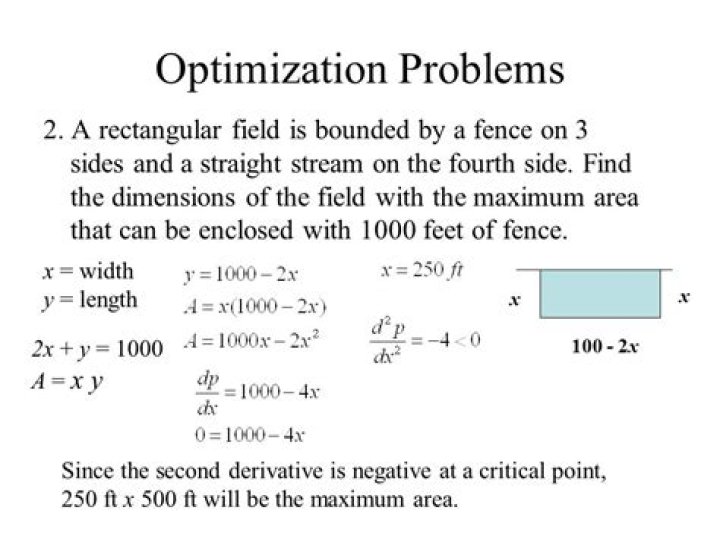
I have been trying to solve the following non-linear optimization problem:
$$\max_{0\leq x \leq 1} N(x\lambda-x^2c)$$
where $\lambda, c >0$.
I think the solution is the following:
If $\lambda\leq2c, \ x^*=\frac{\lambda}{2c},$ and if $\lambda>2c, \ x^*=1$.
Now, consider forcing $Nx$ to be integer to the above problem. The question is: how to obtain an analytical solution, in the presence of above integrality constraint?
Thank you.
$\endgroup$ 31 Answer
$\begingroup$The objective is a concave function of $x$. If the optimal $x$ (without integrality constraint) is between $i/N$ and $(i+1)/N$, the optimal solution with that constraint will be either $i/N$ or $(i+1)/N$, whichever gives a greater objective value (if both are in the interval $[0,1]$).
$\endgroup$