Integral of arctan form
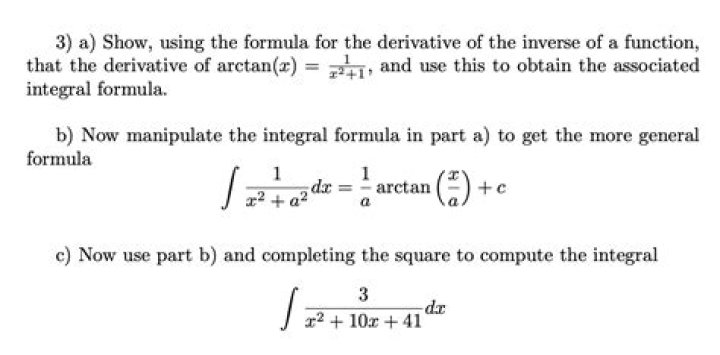
I am trying to solve this integral without techniques ($u$-sub/parts), just simplifying and inspection:
$$ \int \dfrac{1}{4+x^{2}}dx $$
I notice an $\arctan$ form, but that $4$ in the denominator is confusing me, if there was a multiplying factor in front of the $x$ I would know what to do, but stumped on this case.
$\endgroup$ 23 Answers
$\begingroup$One can take a different route with the following. Let $x = 2 t$ to obtain \begin{align} I &= \int \frac{dx}{4 + x^2} \\ &= \frac{1}{2} \, \int\frac{dt}{1 + t^2} = \frac{1}{4} \, \int\left(\frac{1}{1 + i t} + \frac{1}{1 - i t} \right) \, dt \\ &= \frac{1}{4} \, \left[ \frac{1}{i} \, \ln(1 + i t) - \frac{1}{i} \, \ln(1-i t) \right] + c_{1} \\ & = \frac{1}{4i} \, \ln\left(\frac{1+i t}{1- i t}\right) + c_{1}. \end{align} Now using $$\tan^{-1}(y) = \frac{1}{2i} \, \ln\left(\frac{1+ i y}{1 - i y}\right)$$ then the integral becomes, after back substitution, $$\int \frac{dx}{4 + x^2} = \frac{1}{2} \, \tan^{-1}\left(\frac{x}{2}\right) + c_{1} = \frac{1}{4i} \, \ln\left(\frac{2 +i x}{2 - i x}\right) + c_{0}.$$
$\endgroup$ $\begingroup$You should know that $$ \int \dfrac{1}{a^2+x^{2}}dx = \dfrac{1}{a}\cdot \arctan \left( \dfrac{x}{a} \right) + C $$
$\endgroup$ 4 $\begingroup$Doing $x=2y$ and $\mathrm dx=2\mathrm dy$, you get$$2\int\frac2{4+(2y)^2}\,\mathrm dy=\frac12\int\frac1{1+y^2}\,\mathrm dy.$$Can you do the rest?
$\endgroup$