Indefinite integral of secant cubed $\int \sec^3 x\>dx$
I need to calculate the following indefinite integral:
$$I=\int \frac{1}{\cos^3(x)}dx$$
I know what the result is (from Mathematica):
$$I=\tanh^{-1}(\tan(x/2))+(1/2)\sec(x)\tan(x)$$
but I don't know how to integrate it myself. I have been trying some substitutions to no avail.
Equivalently, I need to know how to compute:
$$I=\int \sqrt{1+z^2}dz$$
which follows after making the change of variables $z=\tan x$.
$\endgroup$ 18 Answers
$\begingroup$We have an odd power of cosine. So there is a mechanical procedure for doing the integration. Multiply top and bottom by $\cos x$. The bottom is now $\cos^4 x$, which is $(1-\sin^2 x)^2$. So we want to find $$\int \frac{\cos x\,dx}{(1-\sin^2 x)^2}.$$ After the natural substitution $t=\sin x$, we arrive at $$\int \frac{dt}{(1-t^2)^2}.$$ So we want the integral of a rational function. Use the partial fractions machinery to find numbers $A$, $B$, $C$, $D$ such that $$\frac{1}{(1-t^2)^2}=\frac{A}{1-t}+\frac{B}{(1-t)^2}+ \frac{C}{1+t}+\frac{D}{(1+t)^2}$$ and integrate.
$\endgroup$ $\begingroup$$\newcommand{\+}{^{\dagger}}% \newcommand{\angles}[1]{\left\langle #1 \right\rangle}% \newcommand{\braces}[1]{\left\lbrace #1 \right\rbrace}% \newcommand{\bracks}[1]{\left\lbrack #1 \right\rbrack}% \newcommand{\ceil}[1]{\,\left\lceil #1 \right\rceil\,}% \newcommand{\dd}{{\rm d}}% \newcommand{\down}{\downarrow}% \newcommand{\ds}[1]{\displaystyle{#1}}% \newcommand{\equalby}[1]{{#1 \atop {= \atop \vphantom{\huge A}}}}% \newcommand{\expo}[1]{\,{\rm e}^{#1}\,}% \newcommand{\fermi}{\,{\rm f}}% \newcommand{\floor}[1]{\,\left\lfloor #1 \right\rfloor\,}% \newcommand{\half}{{1 \over 2}}% \newcommand{\ic}{{\rm i}}% \newcommand{\iff}{\Longleftrightarrow} \newcommand{\imp}{\Longrightarrow}% \newcommand{\isdiv}{\,\left.\right\vert\,}% \newcommand{\ket}[1]{\left\vert #1\right\rangle}% \newcommand{\ol}[1]{\overline{#1}}% \newcommand{\pars}[1]{\left( #1 \right)}% \newcommand{\partiald}[3][]{\frac{\partial^{#1} #2}{\partial #3^{#1}}} \newcommand{\pp}{{\cal P}}% \newcommand{\root}[2][]{\,\sqrt[#1]{\,#2\,}\,}% \newcommand{\sech}{\,{\rm sech}}% \newcommand{\sgn}{\,{\rm sgn}}% \newcommand{\totald}[3][]{\frac{{\rm d}^{#1} #2}{{\rm d} #3^{#1}}} \newcommand{\ul}[1]{\underline{#1}}% \newcommand{\verts}[1]{\left\vert\, #1 \,\right\vert}$\begin{align} &\color{#c00000}{\int\sec^{3}\pars{x}\,\dd x}= \int\sec\pars{x}\,\dd\tan\pars{x} = \tan\pars{x}\sec\pars{x} - \int\tan\pars{x}\bracks{\sec\pars{x}\tan\pars{x}}\,\dd x \\[3mm]&= \tan\pars{x}\sec\pars{x} - \int\sec^{3}\pars{x}\,\dd x +\int\sec\pars{x}\,\dd x \\[3mm]&= \tan\pars{x}\sec\pars{x} - \color{#c00000}{\int\sec^{3}\pars{x}\,\dd x} + \ln\pars{\sec\pars{x} + \tan\pars{x}} \end{align}
$\endgroup$ 1 $\begingroup$$$\color{#0000ff}{\large% \int\sec^{3}\pars{x}\,\dd x = \half\bracks{\tan\pars{x}\sec\pars{x} + \ln\pars{\vphantom{\LARGE A}\sec\pars{x} + \tan\pars{x}}}} + \pars{\mbox{a constant}} $$
Hint: rewrite the integral as
$$\int \sec ^3 (x) \, dx$$
Recall the identity $\sec^2(x)=\tan^2(x)+1$.
So, substituting, you get
$$\int\sec(x)(\tan^2(x)+1) \, dx=\int\tan(x)\tan(x)\sec(x) \, dx+\int\sec(x) \, dx.$$
The first integral can be solved by $u$-substitution and integration by parts, while the second, is an identity.
$$\int\tan(x) \, d\sec(x) = \tan(x)\sec(x)-\int\sec(x) \, d\tan(x)$$
But $\int\sec(x) \, d\tan(x)$ is the original integral. So write an equation and solve for $\int \sec^3(x)dx$
$\endgroup$ $\begingroup$Immediate calculation of $$\int \sec ^{3}xdx.$$
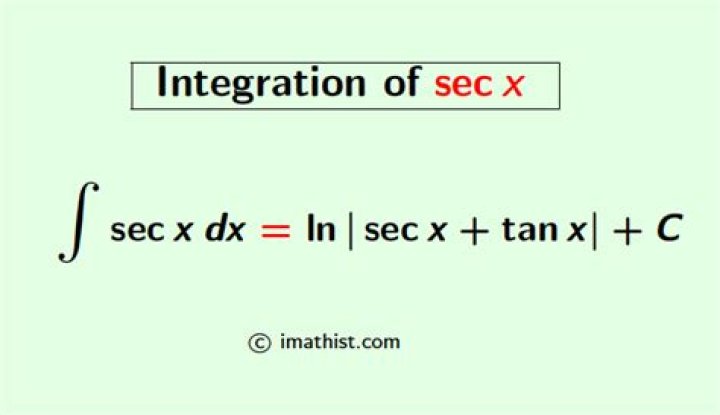
We need the basic formulas of the first two derivatives of $\sec x:$\begin{eqnarray*} (\sec x)^{\prime } &=&\sec x\tan x \\ (\sec x)^{\prime \prime } &=&2\sec ^{3}x-\sec x \end{eqnarray*} Then \begin{eqnarray*} \int \sec ^{3}xdx &=&\frac{1}{2}\int \sec xdx+\frac{1}{2}\int (\sec x)^{\prime \prime }dx \\ &=&\frac{1}{2}\ln \left\vert \sec x+\tan x\right\vert +\frac{1}{2}(\sec x)^{\prime }+C \\ &=&\frac{1}{2}\ln \left\vert \sec x+\tan x\right\vert +\frac{1}{2}\sec x\tan x+C. \end{eqnarray*}
$\endgroup$ $\begingroup$It appears that Mathematica is using the "universal change" for trigonometric integrals $\tan(x/2)=t$: .
$\endgroup$ $\begingroup$$\int \sqrt (1 + x^2) dx$
let $x = \tan \theta $
then $dx = \sec ^2\theta d\theta $
we have the integral is then: $\int \sec ^3\theta d\theta $
recall: $\tan ^2\theta + 1 = \sec ^2\theta $ and write as: $\int \sec \theta (\sec ^2\theta )d\theta $
continue with integration by parts, by letting:
$u = \sec \theta $
and
$dv = \sec ^2\theta d\theta $
we have:
$v = \tan \theta $
and
$du = \sec \theta \tan \theta d\theta $
and thus,
$uv - \int vdu$
is then:
$\sec \theta \tan \theta - \int \sec \theta \tan ^2\theta d\theta $
recall:
$\tan ^2\theta + 1 = \sec ^2\theta $
we have:
$\sec \theta \tan \theta - \int \sec \theta (\sec ^2\theta - 1) d\theta $
after distribution, altogether we have:
$\int \sec ^3\theta d\theta = \sec \theta \tan \theta - \int \sec ^3\theta d\theta - \int \sec \theta d\theta $
rearranging and collecting like-terms:
$2\int \sec ^3\theta d\theta = \sec \theta \tan \theta - \int \sec \theta d\theta $
$2\int \sec ^3\theta d\theta = \sec \theta \tan \theta - \ln |\sec \theta + \tan \theta |$
$\int \sec ^3\theta d\theta = (1/2)[\sec \theta \tan \theta - \ln |\sec \theta + \tan \theta |]$
+++++++++++++++++++++++++++
without u\sin g integration tables, we can derive
$\int \sec \theta d\theta $
..........
$=\int 1/\cos \theta d\theta $
$=\int \cos \theta /\cos ^2\theta d\theta $
$=\int \cos \theta /(1 - \sin ^2\theta ) d\theta $
let $u = \sin \theta $
then $du = \cos \theta d\theta $
we have: $\int 1/(1 - u^2) du$
partial fractions:
$A/(1 - u) + B/(1 + u) = 1$
$A + B = 1$
$A - B = 0$
$A = 1/2$
$B = 1/2$
we have:
$-(1/2)\ln |1 - u| + (1/2)\ln |1 + u|$
by rules of logarithms:
$(1/2)\ln |(1 + u)/(1 - u)|$
$(1/2)\ln |(1 - u^2)/(1 - u)^2|$
by rules of logarithms:
$\ln |\sqrt (1 - u^2)/(1 - u)|$
recall:
$u = \sin \theta $
$\ln |\sqrt (1 - \sin ^2\theta )/(1 - \sin \theta )|$
$\ln |\sqrt \cos ^2\theta /(1 - \sin \theta )|$
$\ln |\cos \theta /(1 - \sin \theta )|$
$\ln |\cos \theta (1 + \sin \theta )/(1 - \sin ^2\theta )|$
$\ln |\cos \theta (1 + \sin \theta )/\cos ^2\theta |$
$\ln |1/\cos \theta + \sin \theta /\cos \theta |$
$\ln |\sec \theta + \tan \theta |$
++++++++++++++++++++++++++++
but the integral of $\int \sec ^3\theta d\theta $ is:
$\int \sec ^3\theta d\theta = (1/2)[\sec \theta \tan \theta - \ln |\sec \theta + \tan \theta |]$ + CONS\tan T
and \sin ce $\tan \theta = x = x/1 =$ opposite/adjacent, with the pythagorean theorem, we derive: hypotenuse = $\sqrt (1 + x^2)$ and thus, $\sec \theta $ = hypotenuse/adjacent = $\sqrt (1 + x^2)$
$\int \sqrt (1 + x^2) dx$ $= (1/2)[x\sqrt (1 + x^2) - \ln |\sqrt (1 + x^2) + x|]$ + CONS\tan T
$\endgroup$ $\begingroup$Let $I = \int \sec^3 x dx$
$$\begin{align} I &= \int \sec^3 \;\; \text{(by parts)} \\ &= \int \sec^2 x \sec x dx \\ &= \tan x \sec x - \int \tan x (\sec \tan x) dx \\ &= \tan x \sec x - \int \sec x (\sec^2 x - 1) dx\\ &= \tan x \sec x - I \int \sec x dx \;\; \text{( No need for "c" yet; still an integral to go)} \end{align}$$
Rearrange:
$$2I = \sec x \tan x + \int \sec x dx$$ so
$$ I - (1/2) \sec x \tan x + \ln (A (\sec x + tan x)) $$ (here, $c = ln|A|$)
For int sqrt (1 + z^2) dz put z = sinh u and obtain an equivalent result
$\endgroup$ $\begingroup$For the integral: $$\int \sqrt{1+x^2}dx$$ Put $x=\sinh(u), dx=\cosh(u)du$ The integral becomes: $$\int (\cosh(u))^2 du$$ Use the definition $$\cosh(u)=\frac{e^u+e^{-u}}{2}$$ to see the integral becomes: $$\int \frac{e^{2u}+2+e^{-2u}}{4}du$$ So remembering $$\int e^{au}du=\frac{e^{au}}{a}$$ The integral evaluates to: $$\frac{e^{2u}}{8}+\frac{e^{-2u}}{-8}+\frac{u}{2}+C=\frac{\sinh(2u)}{4} +\frac{u}{2}+ C=\frac{\sinh(u)\cosh(u)}{2} +\frac{u}{2}+ C $$ Putting every thing in terms of x, the integral is $$\frac{x\sqrt{x^2+1}}{2}+\frac{\sinh^{-1}(x)}{2}+C$$
$\endgroup$