In the figure, $ABCD$ is a parallelogram.
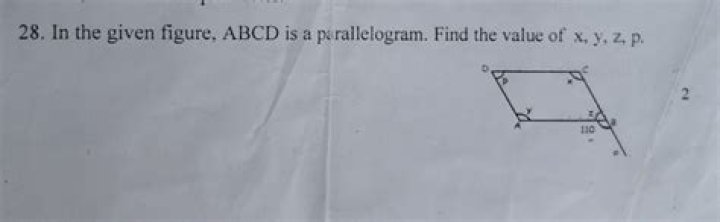
In the figure, $ABCD$ is a parallelogram. $E$ is the mid point of $AB$. $DF$ and $CF$ are intersected at $F$. Prove that $4\triangle AEF=Quadrilateral ABCD$
My Attempt $\triangle DEC=\frac {1}{2} parallelogram ABCD$
$\triangle AED+\triangle EBC=\frac {1}{2} parallelogram ABCD$
Now what should I do next?
$\endgroup$ 32 Answers
$\begingroup$If you look at triangles $FEB$ and $FDC$, you should be able to see that $FB=BC$. This gives you immediately that $\triangle FEB = \triangle BEC$. Also, $\triangle FEB = \triangle AEF$.
Now your own observations are enough to finish the job.
$\endgroup$ $\begingroup$Let the area ABCD be 4.
By drawing the line thru E parallel to AD, intersecting DC at G, we see that the triangles AED , GDE are congruent to each other,and that the triangles BEC , GCE are congruent to each other. Also, the areas of AED and BEC are equal because the heights of D,C above the line AB are equal, and the bases AE,BE are equal. So each of AED, GDE,BEC, GCE has area 1.
Triangles AEF and BEF have equal area because their bases AE,BE are equal and they share the vertex F.
Now BE is parallel to DC, so the triangles BEF and CDF are similar,in a ratio BE:CD=1:2. So the ratio of their areas is 1:4. So the ratio of the area BEF to that of quadrilateral BEDC is 1:3.
So.... AEF=BEF=(1/3)BEDC=(1/3)(ABCD -AED)=(1/3)(4-1)=1=(1/4)ABCD.
$\endgroup$