In how many different ways can you prove that $\sin^2x + \cos^2x = 1$
The standard proof of the identity $\sin^2x + \cos^2x = 1$ (the one that is taught in schools) is as follows: from pythagoras theorem, we have (where $h$ is hypotenuse, $b$ is base and $p$ is perpendicular)$$h^2 = p^2 + b^2$$dividing by $h^2$ on both sides:$$1 = \frac{p^2}{h^2}+\frac{b^2}{h^2}$$since $\sin x = \frac ph$ and $\cos x = \frac bh$, $$1 = \sin^2x+\cos^2x$$
Are there any more innovative ways of proving this common identity?
$\endgroup$ 47 Answers
$\begingroup$Here's a couple of different methods:
Proof using the cosine angel sum formula:$$ 1=\cos(0) =\cos(x + (-x)) =\cos(x)\cos(-x) - \sin(x)\sin(-x) = \cos^2(x) + \sin^2(x) $$Proof using differential equations:Recall the differential equation definitions of $\sin$ and $\cos$: They are the solutions to $f'' = - f$ with the appropriate initial conditions $f(0) = 0$, $f'(0) = 1$ for $\sin(x)$ and $f(0) = 1$, $f'(0) = 0$ for $\cos(x)$. Since solutions to differential equations are unique given the initial conditions, we immediately get $\sin'(x) = \cos(x)$ under this definition. Then:\begin{eqnarray} \frac{d}{dx} \left(\sin^2(x) + \cos^2(x)\right) &=& \frac{d}{dx} \left(\sin^2(x) + \left(\sin'(x)\right)^2\right)\\ &=& 2\sin(x)\sin'(x) + 2\sin'(x)\sin''(x)\\ &=& 2\sin(x)\sin'(x) +2\sin'(x)(-\sin(x)) = 0 \end{eqnarray}hence $\sin^2(x) + \cos^2(x)$ is constant, since its derivative is 0. Plugging in $x=0$ we see that it must equal 1.
Proof using Euler's formula: $$ \sin^2(x) + \cos^2(x) = \left(\cos x + i \sin x\right)\left(\cos x - i \sin x\right) =\left(\cos x + i \sin x\right)\left(\cos (-x) + i \sin (-x)\right)= e^{i x} e^{-i x} = 1 $$Proof using Taylor series:Using the Taylor series:\begin{eqnarray} \sin(x) = \sum_{n=0}^\infty \frac{(-1)^n x^{2n+1}}{(2n+1)!}\\ \cos(x) = \sum_{n=0}^\infty \frac{(-1)^n x^{2n}}{(2n)!} \end{eqnarray}we have $$ \sin^2(x) = \left(\sum_{n=0}^\infty \frac{(-1)^n x^{2n+1}}{(2n+1)!}\right)^2 = \sum_{n=0}^\infty \sum_{m=0}^\infty \frac{(-1)^{n+m} x^{2n + 2m + 2}}{(2n+1)!(2m+1)!} = \sum_{k=0}^\infty x^{2k+2}(-1)^k \sum_{j=0}^k \frac{1}{(2j+1)!(2(k-j)+1)!}= \sum_{k=0}^\infty \frac{x^{2k+2}(-1)^k}{(2k+2)!}\sum_{j=0}^k \binom{2k+2}{2j+1} = -\sum_{k=1}^\infty \frac{x^{2k}(-1)^k}{(2k)!}\sum_{j=0}^{k-1} \binom{2k}{2j+1} $$and $$ \cos^2(x) =\left(\sum_{n=0}^\infty \frac{(-1)^n x^{2n}}{(2n)!}\right)^2 = \sum_{n=0}^\infty \sum_{m=0}^\infty \frac{(-1)^{n+m} x^{2n + 2m}}{(2n)!(2m)!} = \sum_{k=0}^\infty x^{2k}(-1)^k \sum_{j=0}^k \frac{1}{(2j)!(2(k-j))!} = \sum_{k=0}^\infty \frac{x^{2k}(-1)^k}{(2k)!}\sum_{j=0}^k \binom{2k}{2j} = 1 + \sum_{k=1}^\infty \frac{x^{2k}(-1)^k}{(2k)!}\sum_{j=0}^k \binom{2k}{2j} $$Adding these together:$$ \sin^2(x) + \cos^2(x) = 1+\sum_{k=1}^\infty\frac{x^{2k}(-1)^k}{(2k)!}\left(\sum_{j=0}^k \binom{2k}{2j}-\sum_{j=0}^{k-1} \binom{2k}{2j+1}\right)=1+\sum_{k=1}^\infty\frac{x^{2k}(-1)^k}{(2k)!}\left(\sum_{j=0}^{2k} (-1)^j\binom{2k}{j}\right) = 1+\sum_{k=1}^\infty\frac{x^{2k}(-1)^l}{(2k)!} (1 + (-1))^{2k} = 1 $$We use the binomial theorem on the second last step.
Carlson's Theorem: Major overkill to use this one, but it still works. Notice $\cos(x)$, and $\sin(x)$ have exponential type 1. Thus $$ f(x) = \cos^2(\frac{\pi}{4}x) + \sin^2(\frac{\pi}{4}x) - 1 $$has exponential type at most $\frac{\pi}{2} < \pi$. By inspection, you can see that $f(x) = 0$ for $x\in \mathbb{N}$. Hence Carlson's theorem implies $f(x) = 0$ identically.
$\endgroup$ 1 $\begingroup$Calculus
Let $f(x)=\sin^2x + \cos^2x$. Then $f'(x)=0$ and so $f$ is constant, $f(x)=f(0)=1$.
This proof depends on $\sin'=\cos$, $\cos'=-\sin$.
$\endgroup$ 1 $\begingroup$A few proofs I came up with are:
Proof 1: This uses real analysis. Let $f(x) = \sin^2x + \cos^2x \implies f'(x) = 2\sin x \cos x - 2\sin x \cos x = 0$. Thus, $f(x)$ is a constant function. To find the value of $f(x)$, it is sufficient to find $f(c)$, where c is any convenient constant (say 0). Therefore, $f(x) = f(0) = 1$
Proof 2: This uses Euler's representation of complex numbers. We can represent a complex number in the form $z = re^{ix}$, where $r$ is the modulus and $z$ is the argument. If we take the number $z = e^{ix} = \cos x + i\sin x$ (De Moivre's theorem), then $|z| = 1 = \sqrt{\cos^2x + \sin^2x} \implies \cos^2x + \sin^2x=1$.
$\endgroup$ $\begingroup$One way is to use the complex definitions of sine and cosine.$$\sin\theta=\frac{e^{i\theta}-e^{-i\theta}}{2i} \\\cos\theta=\frac{e^{i\theta}+e^{-i\theta}}{2}$$ $$\begin{align*} \sin^{2}\theta + \cos^{2}\theta &= \Big( \frac{e^{i\theta}-e^{-i\theta}}{2i}\Big)^{2}+\Big(\frac{e^{i\theta}+e^{-i\theta}}{2} \Big)^{2} \\ &= -\frac{e^{2i\theta}-2e^{i\theta}e^{-i\theta}+e^{-2i\theta}}{4}+\frac{e^{2i\theta}+2e^{i\theta}e^{-i\theta}+e^{-2i\theta}}{4} \\ &=-\frac{e^{2i\theta}-2+e^{-2i\theta}}{4}+\frac{e^{2i\theta}+2+e^{-2i\theta}}{4} \\ &=\frac{4}{4} \\&=1\end{align*}$$
$\endgroup$ $\begingroup$$$\left(\frac{e^{ix}+e^{-ix}}{2}\right)^2+\left(\frac{e^{ix}-e^{-ix}}{2i}\right)^2$$$$=\frac{1}{4}\left[\left(e^{2ix}+2+e^{-2ix}\right)-\left(e^{2ix}+2+e^{-2ix}\right)\right]=\frac{4}{4}=1$$
$\endgroup$ 1 $\begingroup$1) With identity $a^2-b^2= (a-b)(a+b)$,
$$\cos^2x+ \sin^2x = (\cos x-i\sin x)(\cos x+i\sin x)=e^{-i x}e^{i x}=1$$
2) With double angle identities,
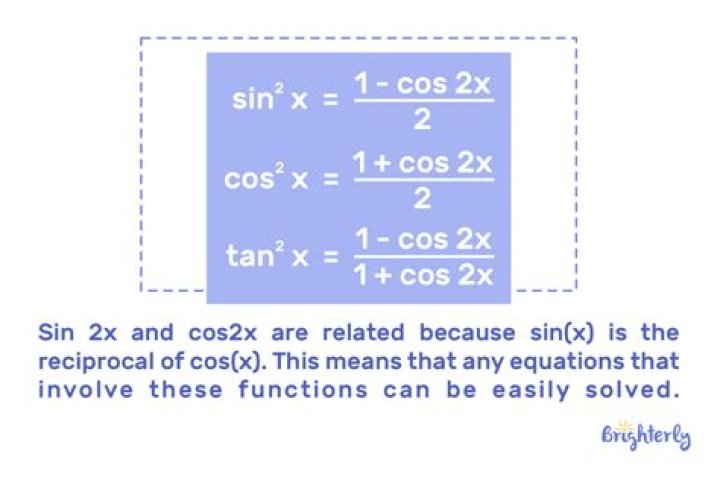
$$\cos^2x+ \sin^2x =\frac12 (1+\cos 2 x)+\frac12(1-\cos 2x)=1$$
3) with half-angle subs $t= \tan\frac x2$,
$$\cos^2x+ \sin^2x =\left(\frac{1-t^2}{1+t^2}\right)^2 +\left(\frac{2t}{1+t^2}\right)^2 =\left(\frac{1+t^2}{1+t^2}\right)^2 =1$$
4) As an integral,
$$f(x)=\cos^2x+ \sin^2x =f(0) + \int_0^x f’(t)dt = 1+0=1$$
5) With $x=it $, apply $\sin(it)= i\sinh t$ and $\cos(it)=\cosh t$
$$\cos^2x+ \sin^2x = \cosh^2 t - \sinh^2 t = \left(\frac{e^t+e^{-t}}{2}\right)^2 -\left(\frac{e^t-e^{-t}}{2}\right)^2 =1$$
$\endgroup$ $\begingroup$Special case of the addition theorems $$\sin(a+b)=\sin(a)\cos(b)+\sin(b)\cos(a)$$and$$\cos(a+b)=\cos(a)\cos(b)-\sin(a)\sin(b)$$by letting $a=-b=x$ in the second theorem. (The slickest prove of those theorems undoubtedly comes from Erhard Schmidt, see Proof of the angle sum identity for $\sin$.)
$\endgroup$ 2