Implicit differentiation $\sin(xy)$
When I check my answer using the implicit differentiation tool on wolframalpha.com, I get a result I can't agree with. So I'd like to hear your opinion :)
Asked: use implicit differentiation to differentiate $\sin(xy)$.
My take on the matter:
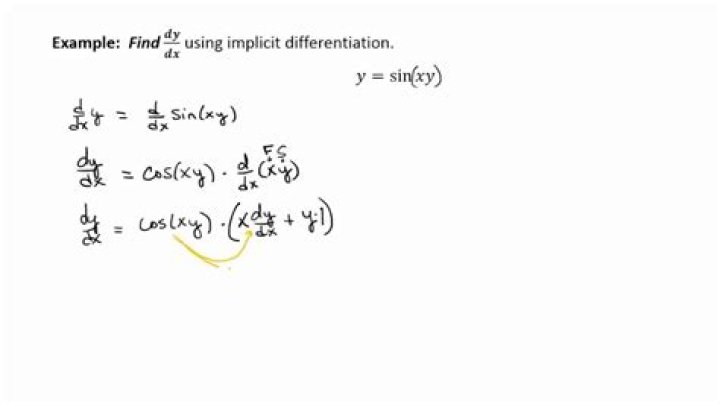
Using the chain rule: $\frac{d}{dx} \sin(xy)$ = $\cos(xy) \frac{d}{dx} xy$, then using the product rule on latter factor we get: $\frac{d}{dx} xy = y + x\frac{dy}{dx}$
Hence: $\frac{d}{dx}\sin(xy) = y \cos(xy) + x \cos(xy) \frac{dy}{dx}$.
Is this correct? Wolframalpha tells me it's simply: $y \cos(xy)$, but perhaps I'm using the tool wrong...
$\endgroup$3 Answers
$\begingroup$Depending on how you entered it into WolframAlpha, it is most likely partial differentiating, meaning it considers $x$ and $y$ to be independent variables (specifically, $\frac{\partial y}{\partial x} = 0$). This is why WA's result is different from yours. If you want WA to interpret $y$ as a function of $x$, you have to write y(x), not just y when you enter $y$ into the expression.
Your results looks fine as it is.
$\endgroup$ $\begingroup$Your answer is correct. I think you didn't type it in correctly for Wolframalpha. Here is the correct way to enter it on Wolfram.
$\endgroup$ $\begingroup$I think you have the function $f(x)=\sin(xy(x))$, where $y$ is a differentiable function of $x$.
In this case your answer is correct.
If you have the function $g(x,y)=\sin(xy)$ of two variables, then Wolfram computed the partial derivative $g_x.$
$\endgroup$