How to use the chain rule for change of variable
I have asked this questions: Change of variables in differential equation?
...but after thinking about it, I am still a little confused of how to rigorously use the chain rule to calculate the derivative(s) of a function for a change of variable.
I have the following derivative:
$f(x) = \frac{dw(x)}{dx}$
Now I introduce the change of variable: $\hat{x}=\frac{x}{L}$and I apply the chain rule:
- I write: $g(\hat{x}) = L \hat{x} = x$
- I substitute: $f(g(\hat{x})) = \frac{dw(g(\hat{x}))}{d(g(\hat{x}))}$
...but this does not help me... I am confusing something.
I would be glad, if someone could show me in detail and step by step how to do this rigorously.
Thanks a lot.
$\endgroup$1 Answer
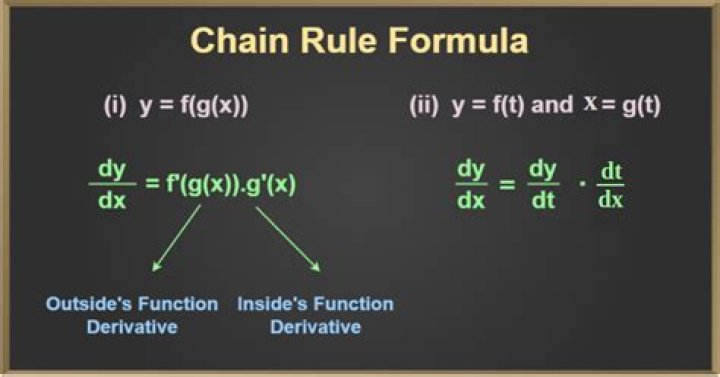
$\begingroup$Let's say you want to change $x$ for $y$, where $y$ is a function of $x$, i.e., $y=g(x)$. I will use $y$ for the nondimensional variable because it's way easier to type in my phone. The chain rule tells us that if we want to calculate the derivative$$\frac{df}{dx}$$in terms of $y$, we need to use the formula$$\frac{df}{dx}=\frac{dy}{dx}\frac{df}{dy}.$$The $dy/dx$ part is equal to $dg(x)/dx$, therefore,$$\frac{df}{dx}=\frac{dg(x)}{dx}\frac{df}{dy}.$$See that it works for any possible change of variables. In your particular case, $g(x)=x/L$ and $dg/dx=1/L$. Therefore, we have$$\frac{df}{dx}=\frac{1}{L}\frac{df}{dy}.$$It leads to$$\frac{df}{dy}=Lw(g^{-1}(y)),$$in which $g^{-1}(y)=Ly$. Finally:$$\frac{df}{dy}=Lw(Ly).$$It's up to you to show that this equation is dimensionally consistent. Remember: $L$ has the same dimension of $x$ and $y$ is nondimensional. Let me know if you have any question.
$\endgroup$ 9