How to solve a one sided limit?
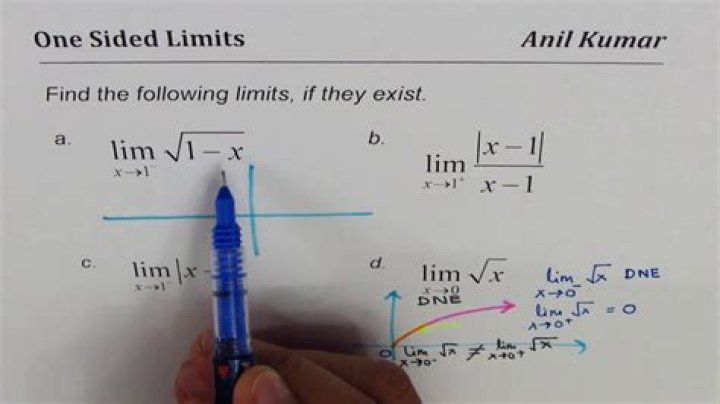
Let $f(x)$ be some function (defined over the reals). How do I find the limit as $x$ approaches $a$ from either the positive or the negative side? (i.e how do I find either $\lim\limits_{x \rightarrow a^+} f(x)$ or$\lim\limits_{x \rightarrow a^- } f(x)$)
$\endgroup$1 Answer
$\begingroup$A one sided limit of $f(x)$ as $x$ approaches $a^+$ (a from the positive side, meaning on the interval $[a,\infty)$) or $a^-$ (a from the negative side, meaning on the interval $(- \infty, a]$) can be easily defined as the value which a function approaches as values of $x$ from the respective (positive or negative) side get progressively closer to $a$.
There are several techniques one can use to find a one sided limit:
Graphically:
To find a one sided limit graphically all that would be necessary is to visually see what the value of $f(x)$ is as $x$ gets arbitrarily close to $a$ from the positive side of the $x$-axis (for $\lim\limits_{x \rightarrow a^+} f(x)$) or from the negative side of the $x$-axis (for $\lim\limits_{x \rightarrow a^- } f(x)$). Take the following graph for example:
To find the limit of $f(x)$ as $x \rightarrow 3^+$, you would start at some $x$ greater than $3$, and then make that $x$ closer and closer to $3$ observing any pattern in the value of $f(x)$, and then looking to see what the value $f(3)$ would be if $f(x)$ continued the same pattern as you have been observing. In this case I might start at four and notice that as I get closer and closer to $3$, $f(x)$ also gets closer to $3$, and I might therefore conclude that $$\lim\limits_{x \rightarrow a^+} f(x)= 3 \ \ .$$
Note: that if the graph has a hole at the point you are approaching, this will not change the limit. Similarly, if the graph gets arbitrarily bigger as you approach $a$, the limit is $\infty$, or if the graph gets arbitrarily more negative the limit is $- \infty$.
Algebraically
While this is not a general rule, if the function is "well behaved" (continuous), meaning it has not holes or jumps or anything like that, then simply plugging in $a$ will yield the limit. However, that is not a general way of finding the limit. A more general way would be to plug in values from whichever side the limit is approaching and see what value, if any $f(x)$ approaches.
An example of this might be $\lim \limits_{x \rightarrow 2^-} \frac{x}{x+2}$. While we could plug in $2$, because this is a "well behaved" function around $2$, if we plug in values closer and closer to $2$ from the negative side we can create a value table as follows (top is $x$, bottom is $f(x)$):
.
This shows us that the value of $f(x)$gets closer and closer to $\frac{1}{2}$ as $x$ gets closer to $2$.
Note: The same disclaimers as in the previous method apply here.
Analytical
A more rigorous way of approaching this problem is through the delta-epsilon definition of the one sided limit, and although this is rarely the approach used in introductory calculus classes, it will be used in most proof-based calculus classes.
The definition of a one sided limit is (as taken from this question):
$\displaystyle \lim_{x \to a^+} f(x) = L$ if and only if For any $\epsilon>0$ there is a $\delta>0$ so that for any $x$, if $0 < x-a <\delta$ then $|f(x)-L| < \epsilon$.
$\displaystyle \lim_{x \to a^-} f(x) = L$ if and only if For any $\epsilon>0$ there is a $\delta>0$ so that for any $x$, if $0 < a-x <\delta$ then $|f(x)-L| < \epsilon$.
Using this you can prove that a certain $L$ is the limit.
Intuitively, this definition simply says that no matter how close you get to $L$, there is always a range of $x$ values which contain $a$ and which, when plugged in to $f(x)$ will be equally as close. In essence, no matter how close $f(x)$ gets to $L$, you can still "approach" it by making $x$ closer and closer to $a$ (from whichever side the limit dictates).
$\endgroup$