How to represent Hadamard product in terms of matrix multiplication?
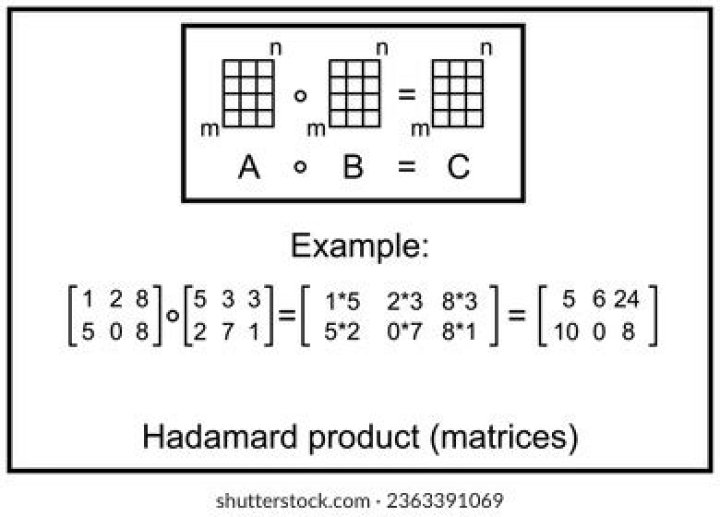
In the case of two vectors $u, v$ with dimensions $n\times 1$, their Hadamard product can be represented by the following matrix multiplication: $$\mathrm{diag}(u)v = \left[\begin{array}{ccc} u_{1} & & 0\\ & \ddots\\ 0 & & u_{n} \end{array}\right]\left[\begin{array}{c} v_{1}\\ \vdots\\ v_{n} \end{array}\right]=\left[\begin{array}{c} u_{1}v_{1}\\ \vdots\\ u_{n}v_{n} \end{array}\right]\equiv u\circ v$$
Is there a way to generalize this for Hadamard products of matrices?
$\endgroup$3 Answers
$\begingroup$Let $\mathcal M_n$ be the space of $n\times n$ matrices (over some field). Then if $A \in \mathcal M_n$ you can define a linear map:$ T_A : \mathcal M_n \to \mathcal M_n$ given by $T_A(B) = A\circ B$, where $\circ$ is the Hadamard/Schur product of $A$ and $B$ (note that this definition is basis dependent!). The matrix units are eigenvectors of this linear transformation:$$ T_A(E_{ij}) = a_{ij}E_{ij},$$where $A=(a_{ij})_{i,j\in[n]}$.
Now $T_A$ is a linear operator, so if you pick a basis for $\mathcal M_n$ you get a matrix representation for it. If you choose the same basis in which you defined the Hadamard product, you get a diagonal matrix of dimension $n^2\times n^2$ whose diagonal entries are the matrix entries of $A$, i.e. the $a_{ij}$ (ordered according of the order of the matrix units you choose).
$\endgroup$ $\begingroup$There is a paper by
Charles R. Johnson and Peter M. Nylen titled
``Hadamard product submultiplicativity of certain induced norms ''
Linear and Multilinear Algebra, 48:2, 165-178
that describes this, there it also says the topic was also covered in
``Largest Singular Value Submultiplicativity'' SIAM journal for Matrix Analysis, 12, 1-6.
You can build upon what you have and create this yourself. The matrices become of size $N^2 * N$ and $N * N^2$, with lots of zeros.
$\endgroup$ $\begingroup$Hadamard product (Schur product) of matrices is element-wise product (two matrices dimension have to be same).
Reference: Topics in matrix analysis.
$\endgroup$