How to remember trig identities?
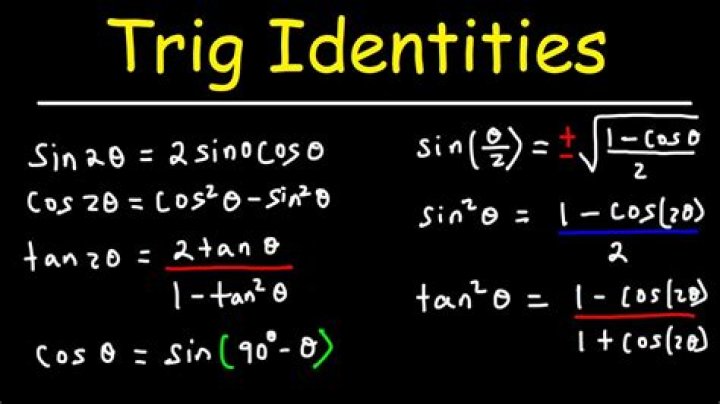
Suppose I have a trig function $T: \Bbb{R} \rightarrow \Bbb{R}$. I want to be able to derive four basic properties:
$$T(x) \cdot T(y)$$ $$T(x) + T(y)$$ $$T(x+y)$$ $$T(cx)$$
where $c$ is some scalar.
I know there are a bunch of identities: reciprocal, quotient, Pythagorean, co-function, even-odd. And then some formulas: product-to-sum, sum-to-product, sum-difference, double angle, half-angle/power-reducing. Here is a list. That's a lot to memorize and some of them seem to overlap.
Why do the four basic properties I mentioned require so many identities to learn? It is a bit cumbersome. Is there an easier way to learn how to do the basic arithmetic operations with trig functions?
$\endgroup$ 85 Answers
$\begingroup$I always found recalling $e^{ix}=\cos x+i\sin x$ useful for quickly deriving the sum of angles formulae, e.g.
$$e^{i(x+y)}=\cos(x+y)+i\sin(x+y).\tag{1}$$
But
$$e^{ix+iy}=e^{ix}e^{iy}=(\cos x+i\sin x)(\cos y+i\sin y).\tag{2}$$
Expanding (2), equating with (1) and separating real and imaginary parts gives you the formulae.
You can then get the double angle formulae easily.
Wait, there's more!
We have $(e^{ix})^n=(\cos x+i\sin x)^n$.
But we also have $$(e^{ix})^n=e^{inx}=\cos(nx)+i\sin(nx),$$ so we get
$$(\cos x+i\sin x)^n = \cos(nx)+i\sin(nx).$$
For example, consider $n=2$, then expanding gives:
$$\cos^2 x-\sin^2 x = \cos(2x)$$ and $$2\sin x\cos x=\sin(2x).$$
This is another way to get the double angle formulae, but you can get more trig identities by letting $n=3, 4, \ldots$. In general, for positive integer $n$ we have
$$\cos(nx) = \Re\left((\cos x+i\sin x)^n\right) =\Re\sum_{k=0}^n{n\choose k}i^k\cos^{n-k}(x)\sin ^k(x)$$ and $$\sin(nx) = \Im\left((\cos x+i\sin x)^n\right)=\Im\sum_{k=0}^n{n\choose k}i^k\cos^{n-k}(x)\sin^k(x).$$
Expanding and simplifying will give you nice trig identities. This is called De Moivre's Theorem.
$\endgroup$ 3 $\begingroup$I find that four suffice.$$\cos^2 (x) + \sin^2(x) = 1 \tag{1}$$$$\cos(a+b)=\cos(a)\cos(b)-\sin(a)\sin(b) \tag{2}$$$$\sin(a+b)=\sin(a)cos(b)+\sin(b)\cos(a) \tag{3}$$$$\text{trig}(x) = \text{cotrig}(\frac{\pi}{2}-x) \tag{4}$$
The Pythagorean identity $(1)$ is easy to manipulate. Divide through by $cos^2(x)$ alternatively by $sin^2(x)$ to find the other forms
$$1 + \tan^2(x) = sec^2(x) \tag{5}$$$$\cot^2(x) +1 = csc^2(x) \tag{6}$$
For the angle addition formulas $(2)$ and $(3)$, we can apply odd and even identities to quickly derive the angle subtraction identities:
$$\cos(a+\color{red}{(-b)})=\cos(a)\cos(\color{red}{(-b)})-\sin(a)\sin(\color{red}{(-b)})$$$$\cos(a-b)=\cos(a)\cos(b)+\sin(a)\sin(b) \tag{7}$$
and
$$\sin(a+\color{red}{(-b)})=\sin(a)cos(\color{red}{(-b)})+\sin(\color{red}{(-b)})\cos(a)$$$$\sin(a-b)=\sin(a)cos(b)-\sin(b)\cos(a) \tag{8}$$
We can also let $a=b$ and substitute in $(2)$ and $(3)$ to find double angle forms
$$\cos(a+a)=\cos(a)\cos(a)-\sin(a)\sin(a)$$$$\cos(2a)=\cos^2(a)-\sin^2(a) \tag{9}$$
$$\sin(a+a)=\sin(a)cos(a)+\sin(a)\cos(a)$$$$\sin(2a)=2\sin(a)cos(a) \tag{10}$$
Combining $(9)$ with the Pythagorean identity $(1)$ gives two more.
$$\cos(2a)=1-2\sin^2(a) \tag{11}$$$$\cos(2a)=2\cos^2(a)-1 \tag{12}$$
If you want a half angle formula, you may as well let $u=2a$ in the previous four identities. Just mind your squares and roots. What happening to tangent? Divide any related $sin$ by $cos$ to get what you need.
Let's not forget product to sum identities! If we take $(2)$ and $(7)$ and add the equation, we find
$$\cos(a+b) + \cos(a-b)=2\cos(a)\cos(b)$$$$\cos(a)\cos(b) = \frac12 (\cos(a+b) + \cos(a-b)) \tag{13}$$
Similar combinations will give the remaining product to sum identities.
As for $(4)$, $trig(x) = cotrig(\frac{\pi}{2}-x)$, I'm referring to cofunction identities, which all have the same form. For example, $\sin(x) = \cos(\frac{\pi}{2}-x).$ That's essentially six more identities.
We have over twenty identities at our disposal now, including the few that I've mentioned but neglected to outright derive.
$\endgroup$ 1 $\begingroup$From the comments to the question:
The definitions of $\tan$, $\csc$, $\sec$, and $\cot$ must be memorized (mnemonic: each pair of reciprocals has one "co" e.g., $(\sin,\csc)$ are a pair) I memorize $\sin^2(x)+\cos^2(x)=1$ and the angle sum/difference formulas. Everything else can usually be derived from those.
This is great because it simplifies everything down to a core set of principles. The problem is then memorizing the sum/difference formulas. I found the following mnemonic in another answer
Blue:
Sine, Cosine, Sign, Cosine, Sine
Cosine, Cosine, Co-Sign, Sine, Sine
The first line encapsulates the sine formulas; the second, cosine. Just drop the angles in (in order $\alpha, \beta, \alpha, \beta$ in each line), and know that "Sign" means to use the same sign as in the compound argument ("+" for angle sum, "-" for angle difference), while "Co-Sign" means to use the opposite sign.
Together, I think this makes a pretty good game plan for tackling trig. For a little more fun, see Antinous' awesome answer.
$\endgroup$ $\begingroup$Stan's answer will probably do a better job than mine; while running the risk of repeating information: memorize $\sin^2(x)$ $+$ $\cos^2(x)$ $=$ $1$, dividing through by $\cos^2(x)$ will yield the identity $\tan^2(x)$ + $1$ $=$ $\sec^2(x)$.
Additionally, dividing through by $\sin^2(x)$ will yield $1 +$ $\cot^2(x)$ = $\csc^2(x)$. Furthermore, intuitively understanding the graphs of $\sin(x)$ and $\cos(x)$ will make life easier.
Finally, going through the unit circle derivations of many trigonometric identities will prove useful in being able to "unstick" yourself should you get stuck.
Edit: Of course, also knowing the basics: $\tan(x)$ $=$ $\frac{\sin(x)}{\cos(x)}$, $\csc(x)$ $=$ $\frac 1{sin(x)}$, $\sec(x)$ $=$ $\frac 1{cos(x)}$ is fundamental.
$\endgroup$ 1 $\begingroup$A systematic way to implement what pbs wrote, is mentioned in the book A = B in section 1.5:
$\endgroup$Let $w = \exp(ix)$, then $\cos x = (w +w^{-1})/2$ and $\sin x = (w - w^{-1}/(2i$). So equality of rational expressions in trigonometric functions can be reduced to equality of polynomial expressions in w. (Exercise: Prove, in this way, that $\sin 2x = 2\sin x\cos x$.)