How to remember sum to product and product to sum trigonometric formulas?
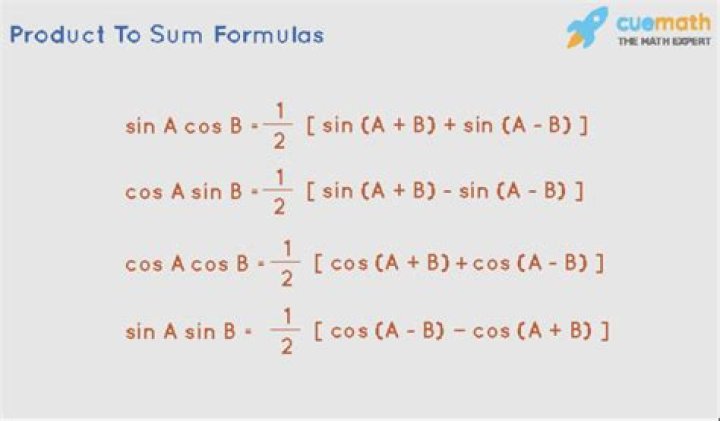
They are:
\begin{align} \cos(a)\cos(b)&=\frac{1}{2}\Big(\cos(a+b)+\cos(a-b)\Big) \\[2ex] \sin(a)\sin(b)&=\frac{1}{2}\Big(\cos(a-b)-\cos(a+b)\Big) \\[2ex] \sin(a)\cos(b)&=\frac{1}{2}\Big(\sin(a+b)+\sin(a-b)\Big) \\[2ex] \cos(a)\sin(b)&=\frac{1}{2}\Big(\sin(a+b)-\sin(a-b)\Big) \\[2ex] \cos(a)+\cos(b)&=2\cos\left(\frac{a+b}{2}\right)\cos\left(\frac{a-b}{2}\right) \\[3ex] \cos(a)-\cos(b)&=-2\sin\left(\frac{a+b}{2}\right)\sin\left(\frac{a-b}{2}\right) \\[3ex] \sin(a)+\sin(b)&=2\sin\left(\frac{a+b}{2}\right)\cos\left(\frac{a-b}{2}\right) \\[3ex] \sin(a)-\sin(b)&=2\cos\left(\frac{a+b}{2}\right)\sin\left(\frac{a-b}{2}\right) \end{align}
I have found nice mnemonics that helped me to remember the reduction formulae and others but I can't find a simple relationship between the formulas above. Can you help?
$\endgroup$ 54 Answers
$\begingroup$The only ones you need to know are the classical $\sin(a+b) = \sin(a)\cos(b)+\cos(a)\sin(b)$ and $\cos(a+b)=\cos(a)\cos(b)-\sin(a)\sin(b)$. The others are mere consequences of those.
For example, by changing the signs, you get $\cos(a-b)=\cos(a)\cos(b)+\sin(a)\sin(b)$. By summing, you have $\cos(a+b)+\cos(a-b) = 2\cos(a)\cos(b)$, which is your first formula.
Similarly, by solving $p=a+b$ and $q=a-b$, you get the formula $\cos(p)+\cos(q) = 2\cos\left(\dfrac{p+q}{2}\right)\cos\left(\dfrac{p-q}{2}\right)$.
$\endgroup$ 1 $\begingroup$Right away, you can cross off the fourth formula, since it is equivalent to the third formula after switching $a$ and $b$.
Then, you can also avoid the last four formulas, since these are all covered by the first three formulas via the relationships $$a+b = u, \quad a-b = v, \quad a = \frac{u+v}{2}, \quad b = \frac{u-v}{2}.$$
So that really leaves us with only three formulas. The first two are merely consequences of the cosine angle addition identity $$\cos(a \pm b) = \cos a \cos b \mp \sin a \sin b,$$ where a suitable addition or subtraction of the two forms of this equation are done; e.g., $$\begin{align*} \cos (a-b) &= \cos a \cos b + \sin a \sin b \\ \cos (a+b) &= \cos a \cos b - \sin a \sin b \\ \hline \cos(a-b) + \cos(a-b) &= 2 \cos a \cos b . \end{align*}$$ A similar concept applied to the sine angle addition identity yields the third (and fourth).
Of course, you can memorize the formulas, or re-derive them, but clearly it's faster to have more formulas memorized as long as you can remember them. What is important to stress is that a vast array of trigonometric identities are all consequences of some very basic identities, and these basic identities are the ones you really need to know.
$\endgroup$ $\begingroup$How about just restating the LHS. For example, you could restate $\cos a\sin b$ as $$\frac{\sin a\cos b +\cos a\sin b + \cos a\sin b - \sin a\cos b}{2}$$ and just figure it out from there. For Example, Let's start off with $\cos a\sin b$ and try to derive $\frac{1}{2}[\sin(a+b) - \sin(a-b)]$ $$ \begin{align} \cos a \sin b &= \frac{1}{2}\bigg[2\cos a\sin b\bigg] \\ &= \frac{1}{2}\bigg[\cos a\sin b + \cos a\sin b\bigg] \\ &= \frac{1}{2}\bigg[\cos a\sin b + \cos a\sin b + 0\bigg] \\ &= \color{red}{\frac{1}{2}\bigg[\cos a\sin b + \cos a\sin b + (\sin a \cos b - \sin a\cos b)\bigg]} \\ &= \frac{1}{2}\bigg[(\cos a\sin b + \sin a \cos b) +(\cos a\sin b - \sin a\cos b)\bigg] \\ &= \frac{1}{2}\bigg[(\cos a\sin b + \sin a \cos b) -(\sin a\cos b - \cos a\sin b )\bigg] \\ &= \frac{1}{2}\bigg[(\cos a\sin b + \sin a \cos b) -(\sin a\cos (-b) + \cos a\sin (-b) )\bigg] \\ &=\frac{1}{2}\bigg[\sin(a+b) - \sin(a-b)\bigg] \end{align} $$
Usually I just remember/figure out the red line.
$\endgroup$ 0 $\begingroup$Parity
You can consider the parity of the functions to help figure out if the identity will involve cos or sin. To see this, substitute multiples of $x$ as $a$ and $b$ ($a=mx$ and $b=nx$, say). Notice that the arguments for each sin/cos in all of the formulas are now some multiple of $x$. So for example when trying to remember the formula for
$$\cos(a)\cos(b) $$
We notice that this function, when we substitute multiples of $x$ in the arguments, is even. So the only plausible sum of cos/sin that can equal to this will is the sum (or difference) of cos. ( Sum of sin will be odd; sum of sin and cos will be neither odd or even.) So we can at least know that
$$\cos(a)\cos(b) = \text{some constant} \times [\cos(\cdot) \pm \cos(\cdot)]$$
Another example, consider$$\sin(a) + \sin(b) $$
When we substitute multiples of $x$ in the arguments, the resulting function of $x$ is odd. So the only plausible product of sin/cos it can equal to is in the form:
$$\sin(a) + \sin(b) =\text{some constant} \times \sin(\cdot) \times \cos(\cdot)$$
One caveat for this is that both $\cos(a) + \cos(b)$ and $\cos(a) - \cos(b)$ will produce even functions when we plug in multiples of $x$. So they can equal to $\cos(\cdot)\cos(\cdot)$ and $\sin(\cdot)\sin(\cdot)$; you need to remember which is which on this case.
Range
Now notice that $\cos(\cdot), \sin(\cdot)$ are bounded between $-1$ and $1$. So, any product of sin/cos is also bounded by $-1$ and $1$. Also, the sum/difference of two sin/cos is bounded between -2 and 2. If we try substituting $a=x$ and $b=-x$, these bounds correspond to the range of the function. Using these we can find out the absolute value for the constants in the front of each formula. For example since
$$-1\leq \cos(a)\cos(b) = \text{some constant} \times [\cos(\cdot) \pm \cos(\cdot)] \leq 1$$
the only plausible absolute value for the constant is $1/2$. Similarly in a sum-to-product conversion, the plausible absolute value for the constant is $2$.
With these we can figure out everything in the formula except for what's inside the arguments of cos/sin and whether to add/subtract (and also that front minus sign in the formula for $\cos(a)-\cos(b)$). So that's all that you really need to memorize.
$\endgroup$