How to open a terminal quickly from a file explorer at a folder in Windows 7?
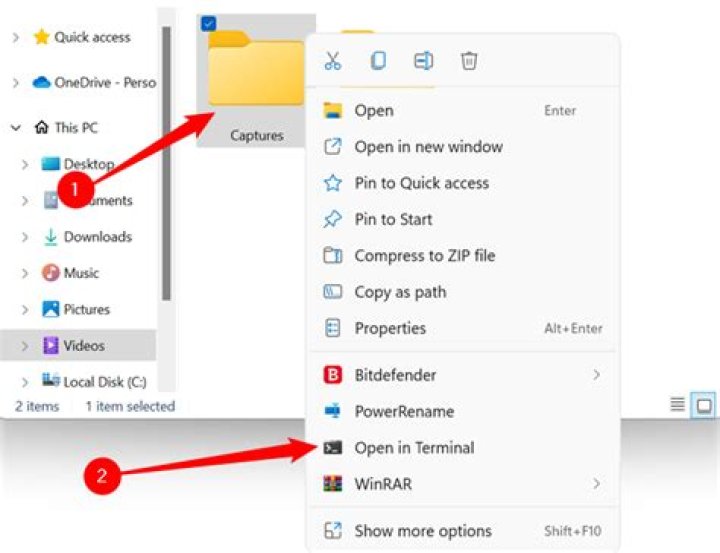
This can be done easily in Ubuntu, just right click and open Terminal. It is very inconvenient to open cmd.exe then cd to the folder.
So, how do I open a terminal quickly from a file explorer at a folder?
17 Answers
- Hold Shift + Right Click the folder you want it opened on, and click "open command window here". That should do the trick!
OR
- You can also type
cmdinto the Windows File Explorer address bar (use Ctrl+L to focus the address bar) and press Enter to open the shell.
You can type cmd in Windows Explorer's location bar (which you can edit with the keyboard shortcut Alt+D); it will open a terminal upon pressing Enter.
Personally I use a voice command in Dragon NaturallySpeaking that takes care of it:
Code:
Sub Main SendKeys "%d" Wait(0.1) SendKeys "cmd" Wait(0.1) SendKeys "{ENTER}"
End SubPress Ctrl+L. This will allow you to edit the location bar address of the file explorer. Type cmd and press Enter. This will open command prompt in current folder.
You can use Andrew Richards' Enhancing the “Open Command Prompt here” Context Menu experience tweak
Just import the below *.reg file (or copy from the MSDN blog above)
Windows Registry Editor Version 5.00
; Command Prompt
[HKEY_CLASSES_ROOT\Directory\shell\01MenuCmd]
"MUIVerb"="Command Prompts"
"Icon"="cmd.exe"
"ExtendedSubCommandsKey"="Directory\\ContextMenus\\MenuCmd"
[HKEY_CLASSES_ROOT\Directory\background\shell\01MenuCmd]
"MUIVerb"="Command Prompts"
"Icon"="cmd.exe"
"ExtendedSubCommandsKey"="Directory\\ContextMenus\\MenuCmd"
[HKEY_CLASSES_ROOT\Directory\ContextMenus\MenuCmd\shell\open]
"MUIVerb"="Command Prompt"
"Icon"="cmd.exe"
[HKEY_CLASSES_ROOT\Directory\ContextMenus\MenuCmd\shell\open\command]
@="cmd.exe /s /k pushd \"%V\""
[HKEY_CLASSES_ROOT\Directory\ContextMenus\MenuCmd\shell\runas]
"MUIVerb"="Command Prompt Elevated"
"Icon"="cmd.exe"
"HasLUAShield"=""
[HKEY_CLASSES_ROOT\Directory\ContextMenus\MenuCmd\shell\runas\command]
@="cmd.exe /s /k pushd \"%V\""
; PowerShell
[HKEY_CLASSES_ROOT\Directory\shell\02MenuPowerShell]
"MUIVerb"="PowerShell Prompts"
"Icon"="powershell.exe"
"ExtendedSubCommandsKey"="Directory\\ContextMenus\\MenuPowerShell"
[HKEY_CLASSES_ROOT\Directory\background\shell\02MenuPowerShell]
"MUIVerb"="PowerShell Prompts"
"Icon"="powershell.exe"
"ExtendedSubCommandsKey"="Directory\\ContextMenus\\MenuPowerShell"
[HKEY_CLASSES_ROOT\Directory\ContextMenus\MenuPowerShell\shell\open]
"MUIVerb"="PowerShell"
"Icon"="powershell.exe"
[HKEY_CLASSES_ROOT\Directory\ContextMenus\MenuPowerShell\shell\open\command]
@="powershell.exe -noexit -command Set-Location '%V'"
[HKEY_CLASSES_ROOT\Directory\ContextMenus\MenuPowerShell\shell\runas]
"MUIVerb"="PowerShell Elevated"
"Icon"="powershell.exe"
"HasLUAShield"=""
[HKEY_CLASSES_ROOT\Directory\ContextMenus\MenuPowerShell\shell\runas\command]
@="powershell.exe -noexit -command Set-Location '%V'"
; Ensure OS Entries are on the Extended Menu (Shift-Right Click)
[HKEY_CLASSES_ROOT\Directory\shell\cmd]
"Extended"=""
[HKEY_CLASSES_ROOT\Directory\background\shell\cmd]
"Extended"=""
[HKEY_CLASSES_ROOT\Directory\shell\Powershell]
"Extended"=""
[HKEY_CLASSES_ROOT\Directory\background\shell\Powershell]
"Extended"=""
As I don't have access to any Win7 machine right now i'll give you 2 answers, one that I know that works in winXP and one that I found but don't know if it works in Win7.
- WinXP Solution - Registry Option
- Win7 Solution
Update for Windows 10 when CMD was replaced by PowerShell:
For quite some time, there is a PowerShell module called OpenHere that gives you granular options to control this functionality.
All you need is to copy paste this into PowerShell with elevated rights:
Install-Module -Name OpenHere; Import-Module -Name OpenHereand start to explore the Set-OpenHereShortcut function.
Disclosure:
I'm a developer of this module.
2For Mac:
Head into System Preferences and select Keyboard > Shortcuts > Services. Find "New Terminal at Folder" in the settings and click the box. Now, when you're in Finder, just right-click a folder and you're shown the open to open Terminal.
source:
2