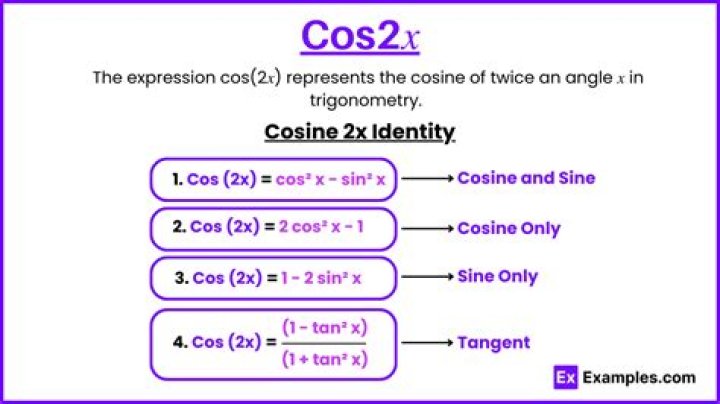
How to get to the other forms of the identity $\cos2x = \cos^2x -\sin^2x$
I'll need to memorize $\cos2x = \cos^2x - \sin^2x$ as I'll use it in derivatives.
Only, there are other forms for this identity, I can't see how I can get to the others from this one above.
The other forms are
$$2\cos^2x - 1\\ 1 - 2\sin^2x$$
$\endgroup$ 15 Answers
$\begingroup$You can do it by using the Pythagorean identity: $\sin^2 x+\cos^2 x =1$. This can be rewritten two different ways:
$$\sin^2 x = 1- \cos^2 x$$
and
$$\cos^2 x = 1 - \sin^2 x$$
Use either of these formulas to replace the $\sin^2 x$, or the $\cos^2 x$, on the right side of your identity. That will give you the other two forms.
$\endgroup$ $\begingroup$$$\cos 2x$$ $$=\cos^2 x-\sin^2 x$$ $$=2\cos^2 x-(\sin^2 x+\cos^2 x)$$ $$=2\cos^2 x-1$$ On the other hand, $$\cos 2x$$ $$=\cos^2 x-\sin^2 x$$ $$=\cos^2 x+\sin^2 x-2\sin^2 x$$ $$=1-2\sin^2 x$$
$\endgroup$ $\begingroup$This is because $\sin^2x + \cos^2=1$
$$\cos^2x - \sin^2x$$ $$=2\cos^2 -(\sin^2x+\cos^2x)=2\cos^2x-1$$ $$=(\cos^2x+\sin^2x)-2\sin^2x=1-2\sin^2x$$
$\endgroup$ $\begingroup$I remember this easiest using Euler's identity:
$$ e^{i2x} = \cos2x + i\sin2x $$
and remembering that $e^{inx} = \left(e^{ix}\right)^n$ consider,
$$ \left(e^{ix}\right)^2 = \left(\cos x + i\sin x \right)^2 = \cos^2 x + 2i\cos x\sin x - \sin^2 x $$
Now equate the real parts, $$\Re[e^{i2x}] = \Re[\left(e^{ix}\right)^2]\implies \cos2x=\cos^2x-\sin^2x $$
$\endgroup$ $\begingroup$\begin{align} \cos 2\theta &= \cos^2 \theta - \sin^2 \theta\\ 1 &= \cos^2 \theta + \sin^2 \theta \\ \end{align}
Adding, you get \begin{align} \cos 2\theta + 1 &= 2 \cos^2 \theta \\ \cos 2\theta &= 2 \cos^2 \theta - 1 \\ \end{align}
Subtracting, you get \begin{align} \cos 2\theta - 1 &= -2 \sin^2 \theta \\ \cos 2\theta &= 1 - 2 \cos^2 \theta \\ \end{align}
$\endgroup$