How to find Wronskian of this ordinary differential equation problem
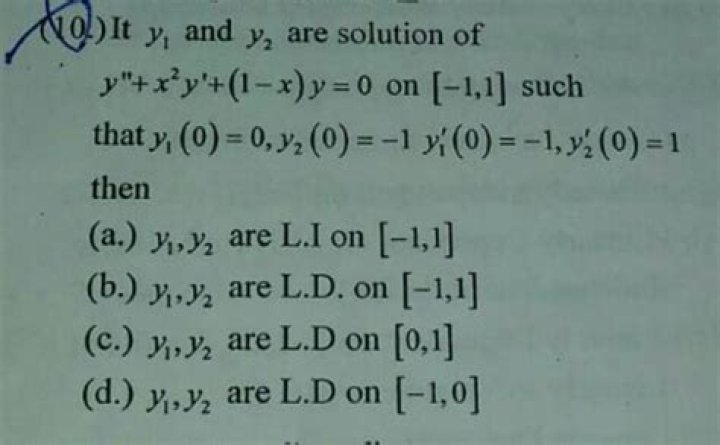
I know how to find the Wronskian if solutions are available. And if I can solve the problem.
I don't know how to solve this problem.
Is there a way to find the Wronskian of this problem without actually using the solution process used in variable coefficients?
I am just interested in the Wronskian. I have just tried so far substitutions which lead no where.
$\endgroup$ 22 Answers
$\begingroup$If $w=w(y_1,y_2)(t)$ a the Wronskian of $y''+p(x)y'+q(x)y=0$, then $$ w'=(y_1y_2'-y_1'y_2)'=y_1y_2''-y_1''y_2=y_1(-py_2'-qy_2)-y_2(-py_1'-qy_1)=-pw $$ Thus $$ w(x)=w(x_0)\,\exp\left(\int_{x_0}^x p(s)\,ds\right). $$ In your case $$ w(t)=\left|\begin{array}{rr}0 & -1 \\ -1 & 1\end{array}\right|\exp(-x^3/3)=\exp(-x^3/3) $$
$\endgroup$ 0 $\begingroup$The wroskian is the determinant: $$\begin{vmatrix} y_1 & y_2 \\ y_1' & y_2'\end{vmatrix}=y_1y_2'-y_2y_1'$$ There's a theorem that states that, if $y_1,y_2$ are solution's of an second order linear homogeneus equation, then they are LI in some interval iff the wronskian does not vanish in that interval, now see what's your wronskian when evaluated at zero.
$\endgroup$ 3