How to express a 2nd order ODE as 1st order ODE's?
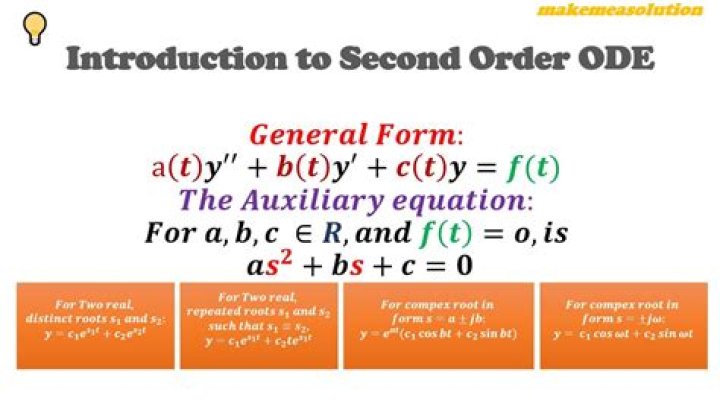
Express the 2nd order ODE
$$\begin{align}\mathrm d_t^2 u:=\frac{\mathrm d^2 u}{\mathrm dt^2}&=\sin(u)+\cos(\omega t)\qquad \omega \in \mathbb Z /\{0\} \\u(0)&=a\\\mathrm d_t u(0)&=b\end{align}$$
as a system of 1st order ODEs and verify there exists a global solution by invoking the global existence and uniqueness theorems.
I'm not sure how to express second order ODEs as first order ODEs, any tips?
$\endgroup$ 22 Answers
$\begingroup$Here's an example to get you started:
$$u^{(3)}(t)+t^3u''(t)+5u'(t)+\sin(t)u=e^{6t}$$
with initial values $u''(0)=1$, $u'(0)=2$, and $u(0)=3$
First, give new names to $u$ and its derivatives (stopping one short of the order of the ODE): $u=x_1$, $u'=x_2$, $u''=x_3$.
Substituting back into the DE (keeping in mind that $u^{(3)}(t)=x'_3(t)$) we get: $$x'_3(t)+t^3x_3(t)+5x_2(t)+\sin(t)x_1(t)=e^{6t}$$
Thus we have the equivalent system:
$$\begin{array}{ccrrrr} x'_1 & = & & x_2 & & \\ x'_2 & = & & & x_3 & \\ x'_3 & = & -\sin(t)x_1 & -5x_2 & -t^3x_3 & +e^{6t} \end{array}$$
Also, $x_1(0)=3$, $x_2(0)=2$, and $x_3(0)=1$.
$\endgroup$ $\begingroup$To convert second-order ODE to a first-order system you have to introduce new variables:
$u_1=u$
$u_2=u'_t$
Now we can write following:
$(u_1)'_t=u_2$
$(u_2)'_t=u''_t=\sin(u_1)+\cos(\omega t)$
with the initial condition $u_1(0)=a$ , $u_2(0)=b$
$\endgroup$