How to calculate the work done to move water into a hemispherical tank from the bottom.
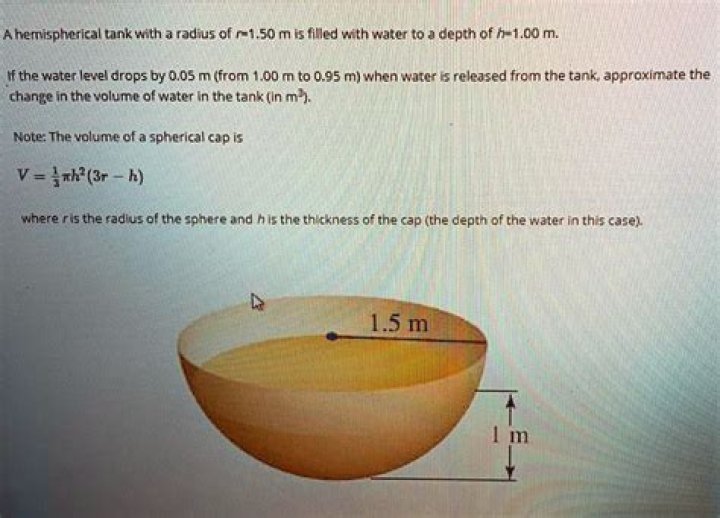
Problem
A hemispherical tank of radius 2 feet is positioned so that its base is circular. How much work is required to fill the tank with water through a hole in the base when the water source is at the base? (The weight-density of water is 62.4 pounds per cubic foot.)
To find the Work I first needed to find the Force because Work = force*distance. To do this I am using the "disc-method" which subdivides a 3d solid into discs, in this case, a dome.
Finding the force
To find the force I first need to find the volume of each disc and then multiply by the density, which the problem says is 62.4 lb/ft, so I only need to find the volume of each disc.
The Volume of a disc is $\pi r^2h$ so while the height of each disc will end up being equivalent to dy, I will have to find radius as a function of y for every disc.
Radius of each disc
Attempting to follow this video, I was able to see that I could write the radius of each disc as a function of y by using the Pythagorean theorem.
In this case, because $x^2+y^2=z^2$ and $z^2$ can be equal to the radius, that gives $x^2+y^2=2$. Finally, simplifying, showing x as a function of y:
$$x^2=2-y^2$$
Now that I have the radius in terms of y, I can plug that back into the formula for the volume of our discs giving: $$\pi (2-y^2)dy$$
Then, multiplying by the given density of water(62.4lb/ft), we get the force:$$\pi (2-y^2)62.4dy$$
Then for every disc, and not just some disc:$$\int_0^2 {\pi (2-y^2)62.4}dy$$
Finishing up
Now that I have the equation for the force of every disc combined, I just need to multiply by the distance traveled by each disc which is the same as the height of the dome(2ft.), which gives:
$$\int_0^2 {\pi (2-y^2)62.4*2}dy = 522.761$$
Unfortunately though, this is incorrect, and I'm not sure where I've gone wrong.
$\endgroup$ 41 Answer
$\begingroup$Ignoring friction etc., it's just like pumping up the same amount of water to a height where the center of mass of the hemisphere is located. For the center of mass of a hemisphere, see this question.. Hence the needed energy is$$E = \rho\cdot V \cdot g\cdot h_\text{center_of_mass}$$
- $\rho$ is the density of the fluid
- $V$ is its volume ($2\pi/3r^3)$
- $g$ is gravitational acceleration (assuming it is constant, $\approx9.81\mathrm{m/s^2}$)
If you are imperial, be aware of conversion factors.
Note: One error is that you are using $x^2=r-y^2$ where the correct one is$$x^2 = r^2-y^2$$with $r^2=4$.
Second error is that you are integrating the weights (forces) of the slices, which gives a force and this cannot be right, because the outcome will have dimension of force, but should be energy. Gravitational potential energy is Force × Displacement (provided force and displacement are parallel, which is the case here). Thus the integrand is missing a factor of $y$.
Hence a final recommendation: Resist the temptation to plug in constants and then have to carry around magic values (and their units). Try to derive a formula, and then finally plug in all the values and check that the dimensionality works out correctly like kg·m2/s2 or poundmass·foot2/s2
$\endgroup$ 1