How to apply De Morgan's law?
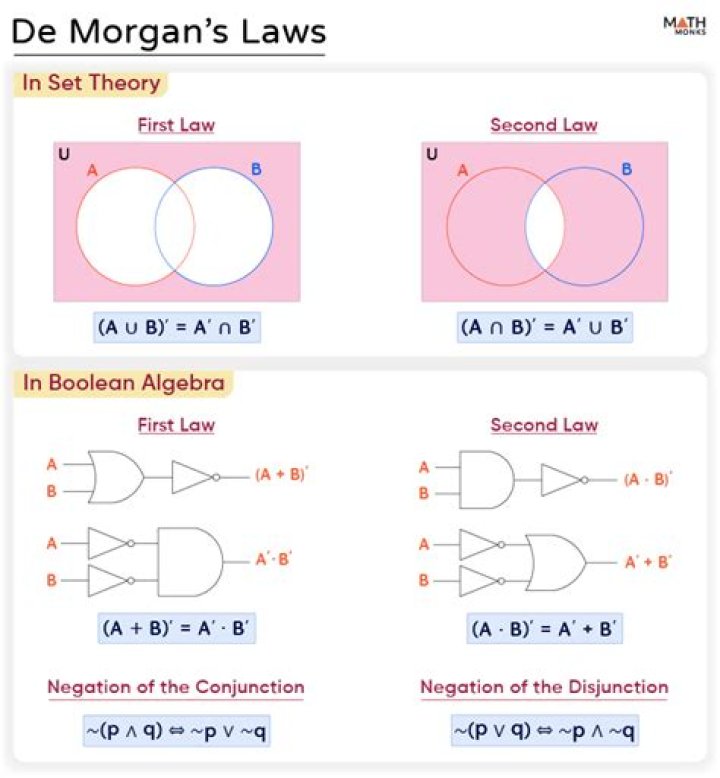
If for De Morgan's Laws
$$( xy'+yz')' = (x'+y)(y'+z)$$
Then what if I add more terms to the expression ...
$$(ab'+ac+a'c')' = (a'+b)(a'+c')(a+c)?$$
$\endgroup$2 Answers
$\begingroup$We'll apply DeMorgan's "twice", actually, and get:
$$(ab'+ac+a'c')' = (ab')'(ac)'(a'c')' = (a'+b)(a'+c')(a+c)$$
So, yes, you are correct!
You can, likewise, apply (and/or "doubly apply") DeMorgan's to an indefinite number of terms, e.g.:
$$(ab + cd + ef + \cdots + yz)' = (a' + b')(c' + d')(e' + f')\cdots(y' + z')$$
$\endgroup$ 6 $\begingroup$Yes. I think this basically has to do with closure. Compactly, we can say that both of the De Morgan's laws fall under the equation (xXy)'=(x'Yy') where X, Y belong to {$\land$, $\lor$} and X does not equal Y, and "x", "y" consist of any Boolean expression. So, if we have something like (ab'+ac+a'c')' we can write that as (ab'+(ac+a'c'))' and apply one of the De Morgan Laws to get (ab')'(ac+a'c')', and so on.
So, via induction you can prove that (a$_1$X...Xa$_n)$'=($a_1$'Y...Ya$_n$') where X, Y belong to {$\land$, $\lor$} and X does not equal Y, and "a$_1$", ..., "a$_n$" consist of any Boolean expression.
$\endgroup$ 1