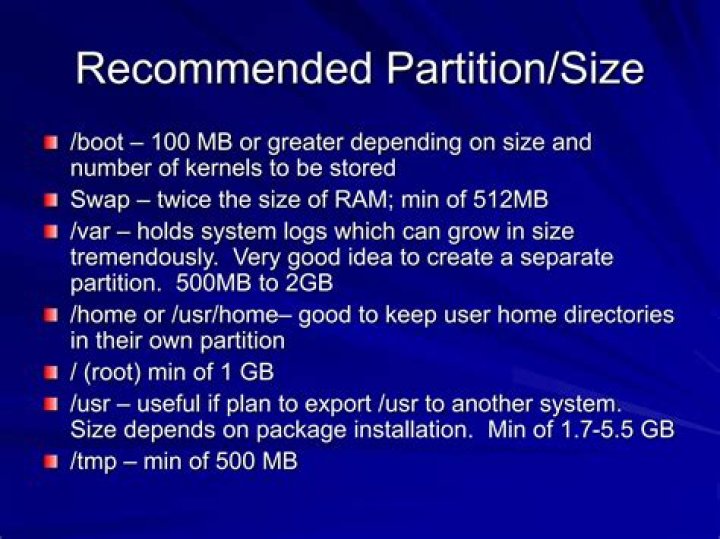
How large should I make root, home, usr, var, and tmp partitions?
i install ubuntu server 10.04, have 64 Gb VHD.
And want to separate partitions in this mode:
/dev/xvda0 p on swap (2 Gb)
/dev/xvda1a0 e on /boot (128 Mb)
/dev/xvda1a1 e on / type ffs (local)
/dev/xvda1a2 e on /usr type ffs (local, nodev)
/dev/xvda1a3 e on /tmp type ffs (local, nodev)
/dev/xvda1a4 e on /var/log type ffs (local, nodev)
/dev/xvda1a5 e on /var type ffs (local, nodev, nosuid)
/dev/xvda1a6 e on /home type ffs (local, nodev, nosuid, with quotas)
/dev/xvda2 p on /new (local, nodev, nosuid, noexec) with rest of space ~50Gb.
But i'ma stuck, and don't know what size to give to each folder.
Also i want to encrypt partitions.
Thank you for any tips.
EDIT: System need minimum size, here will be installed about 10 apps like ufw, apache,mysql, chkrootkit and so on.
04 Answers
First, I would put all space, except /boot, in a LVM2 volume. That's because it makes it so much easier to adjust partition size later, even on live systems and modern file systems.
Then I would make root small about 1GB, /usr about 6GB, /var about 2GB, /boot about 512 MB, swap same size as RAM, /var/log, /home and /srv large enough. It can be adjusted later.
I would not used all unallocated space now, as that could later be used to expand the other partitions, as I'm using LVM2. I could even add new paritions like /tmp, but that is a bit more complicated. I never use anything but LVM2 anymore. With that, I can even move the installation to RAID disks in less than 30 minutes, including creating and copy files and all.
For more information about LVM2, read this:
Yes, about encryptions, please have a look at Luks support:
- (Package cryptsetup) file:/usr/share/doc/cryptsetup/README.remote.gz
There is no correct or wrong answer,personally i would make a 12GB partition for my Ubuntu installation containing:
-> 6GB for root
-> 2GB for swap
-> 4GB for home
Since this is an older versno 10 - my obervation using ubuntu 20 installed about 1 year ago - with 32 GB RAM and 1 TB HDD,are as: I do not have any major application other than openvpn, openssh, few drivers, virtualbox latest, additional printer drivers, I use wifi-usb dongle to connect to internet.
root: / - even without mysql/oracle any other software -- its already 2 gb used up! I would suggest keep min. 4gb if you just use OS /browser, otherwise keep at least 6 to 8 gb
/usr -- i have a single /usr with /usr/local/xx -- all local software, ClamAV, etc. etc in it right now its 6gb used up -- i would sugges keep this to 16 gb if you plan to update/add tools/etc every now and then for one year
/var -- I regret keeping this partition just 6gb ( 5.7 gb usable for installation) -- its now 94% full -- w/o any major software in use. I would suggest to keep this 8 to 16 gb as per your usage or little more if possible.
/tmp, swap -- keep min. 16 gb for /tmp (6 gb if you're constrainted) and SWAP partitions .
All would still work with jut 64 GB -- compare it with current versions of windows which need around 80-100 gb plus PAGE files ( 16gb approx) to work ok after frequent updates/patches .
The correct answer is: / 500 gb (which is used by /tmp, /var, and /home. /Home is your long term storage whereas /tmp and /Var are short term; it stores almost everything so make it big. By also making it big, you Enable your computer to work with say a 498 gb file, so you could download afike that huge.
/Boot (1gb) /Usr (20gb) /Root (5gb) /Swap (2gb prevents failures, 2gb spillover)
By having a seperate /boot, /root and /usr, it makes backing your system that much easier. Once restored if still problem, delete user account and make new one. This is how you do it.
2