How does the laplacian act on a vector?
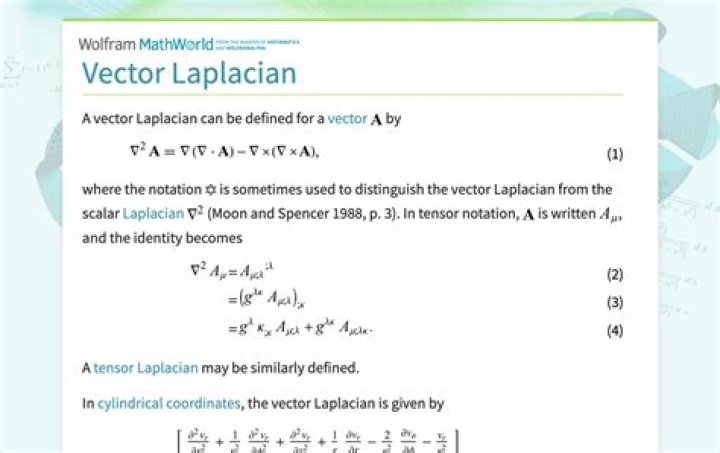
How does the laplacian act on a vector?
I mean
Let
$$ A=(A_x,A_y,A_z) $$
which is right
$$ \nabla^{2}A=(\nabla^{2}A_x,\nabla^{2}A_y,\nabla^{2}A_z) $$ Or $$ \nabla^{2}A=(\nabla^{2}_x A_x,\nabla^{2}_y A_y,\nabla^{2}_z A_z) $$
Also, if $\phi$ is a scalar then is $\nabla^{2}\phi$ a vector or a scalar. Thanks
$\endgroup$ 52 Answers
$\begingroup$The Laplacian preserves "tensor order", eg, the Laplacian of an $n$th order tensor field is an $n$th order tensor field. Therefore the Laplacian of a scalar field is a scalar field.
For vector fields, in a linear coordinate system, the vector Laplacian $\nabla^2\mathbf{A}$ can be calculated by calculating the scalar Laplacian of each component separately, eg. if $\mathbf{A}=A_1\mathbf{e}_1+A_2\mathbf{e}_2+A_3\mathbf{e}_3$, then $\nabla^2\mathbf{A}=(\nabla^2A_1)\mathbf{e}_1+(\nabla^2A_2)\mathbf{e}_2+(\nabla^2A_3)\mathbf{e}_3$.
For curved coordinate systems, this formula does not hold, because the variations of the basis vectors also need to be taken into account.
$\endgroup$ $\begingroup$$\Delta u = \mathrm{div} \cdot \nabla u $
where
$\displaystyle \Delta := \sum_{i=1}^3 \frac{\partial^2}{\partial x^{2}_i}$
$\displaystyle \mathrm{div} = \nabla:= \left ( \frac{\partial}{\partial x_1} , \frac{\partial}{\partial x_2} , \frac{\partial}{\partial x_3} \right )$
$\cdot$ is scalar product.
$\endgroup$