How do you determine whether a curve uses arc length as a parameter?
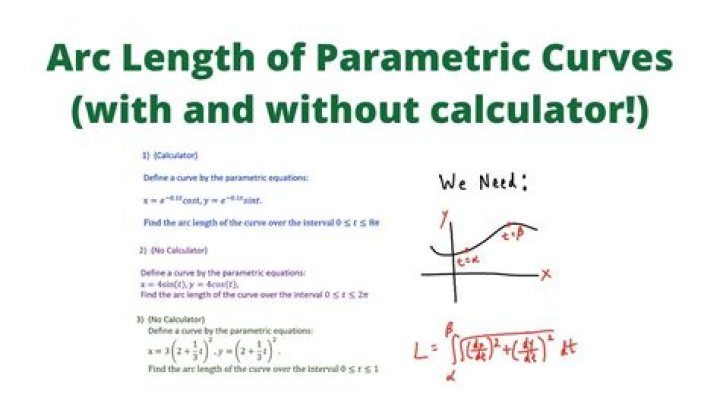
I know how to find arc length because it's simply a matter of plugging in values into a formula:
s(t) = $\int_a^t |v(u)|\,du$
But given an equation r(t), how do I show whether or not the curves use arc length as a parameter? e.g) $r(t) = <2 \cos{t}, 2 \sin{t}>$ for $0 \leq t \leq 2\pi$
I did some calculating and figured this much out:
$$v(t) = \left< -2\sin{t}, 2\cos{t}\right >$$
$$|v(t)| = 2$$
$$s(t) = 2t$$
Any examples or tips?
$\endgroup$ 41 Answer
$\begingroup$A parametrized $r(t)$ is parametrized by arclength when $t=s(t)$, where the arclength $s(t)$ is given by $$ \int_{t_0}^t\|r'(t)\|dt $$ In your example you found that $$ s(t)=2t $$ Since $t\neq 2t$, we can conclude that $r$ is not parametrized by arclength.
If, on the other hand, you were given $$ r(t)=\left\langle -2\sin\frac t2, 2\cos \frac t2 \right\rangle $$ You would find $$ \|r'(t)\|=1\implies s(t)=t $$ Which would mean that $r$ is parametrized by arclength.
As you can see, this also means that $r$ is parametrized by arclength whenever $\|r'(t)\|=1$ for all $t$.
$\endgroup$ 1