How do you deal with inverse trig functions that produce results outside their domain?
The problem I am facing is this:
Find $\cos(X) = 4/7$ in quadrant IV (of the Cartesian plane)
The next step leads me to this:
$X = \cos^{-1}(4/7)$
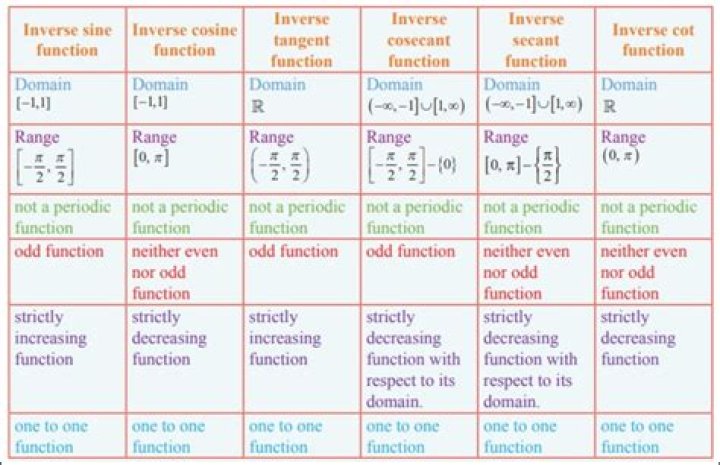
However, I know that the domain of Cosine inverse is restricted to quadrants I and II. So how do I answer the question? Is it no solution? Thank you for your time. Please let me know if I need to fix my question in any way.
$\endgroup$ 72 Answers
$\begingroup$Consider the diagram below:
Observe that $$\cos\theta = \cos(-\theta) = \cos\varphi = \frac{4}{7}$$ Moreover, the first-quadrant angle I have labeled $\theta$ satisfies $$\theta = \arccos\left(\frac{4}{7}\right)$$ Thus, one fourth-quadrant angle with cosine equal to $4/7$ is $-\theta$. If you want one that satisfies the inequalities $0 \leq x < 2\pi$, then set $$x = \varphi = 2\pi - \theta = 2\pi - \arccos\left(\frac{4}{7}\right)$$
$\endgroup$ $\begingroup$By "quadrant IV" I assume you mean the range $\frac{3\pi}2 \le X \le 2\pi$. You are right that using the inverse cosine function will not answer this question as stated, because the values of the inverse cosine, by definition, always lie between $0$ and $\pi$. However, basic properties of trig functions should allow you to reduce to this case. For example, it is true that $\cos (2\pi-\theta) = \cos\theta$ for all $\theta$. Can you use this to reduce to the "quadrant I" case, which I know you can sovle?
$\endgroup$ 1