How do $\ln$ and $e$ cancel out when there is an exponent that is negative?
I have a question about $\ln$ and $e$.
Essentially I know that $e$ and $\ln$ cancel/reverse each other to give $x$. Ex: $e^{\ln x} = x$
But how does this work: $-e^{-\ln 2} = -1/2$
I thought it would just give me $-(-2)$.
$\endgroup$ 12 Answers
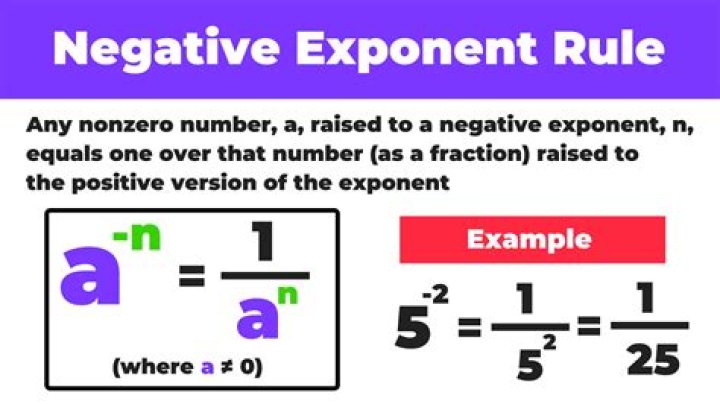
$\begingroup$Recall that that $a^{-b}= (a^b)^{-1}$.
Thus $e^{-\ln 2}= (e^{\ln 2})^{-1}= 2^{-1}= 1/2$.
$\endgroup$ 3 $\begingroup$We know that $e^{\ln x} = x$ and $p \ln x = ln x^p$.
Using this we get
$$ -e^{-\ln 2} = -e^{-1\ln 2}= -e^{\ln 2^{-1}} = -e^{ln(\frac{1}{2})}= -\frac{1}{2}. $$
$\endgroup$ 0