How do I prove a sequence is Cauchy
I was hoping someone could explain to me how to prove a sequence is Cauchy. I've been given two definitions of a Cauchy sequence:
$\forall \epsilon > 0, \exists N \in \mathbb{N}$ such that $n,m> N$ $\Rightarrow |a_n - a_m| ≤ \epsilon$
and equivalently $\forall \epsilon > 0, \exists N \in \mathbb{N}$ such that $n> N$ $\Rightarrow |a_{n+p} - a_n| ≤ \epsilon$, $\forall p \in \mathbb{N}$
I understand that proving a sequence is Cauchy also proves it is convergent and the usefulness of this property, however, it was never explicitly explained how to prove a sequence is Cauchy using either of these two definitions. I'd appreciate it if someone could explain me how to prove a sequence is Cauchy perhaps $a_n = \sqrt{n+1} - \sqrt{n}$ ? or another example just for me to grasp the concept.
$\endgroup$ 32 Answers
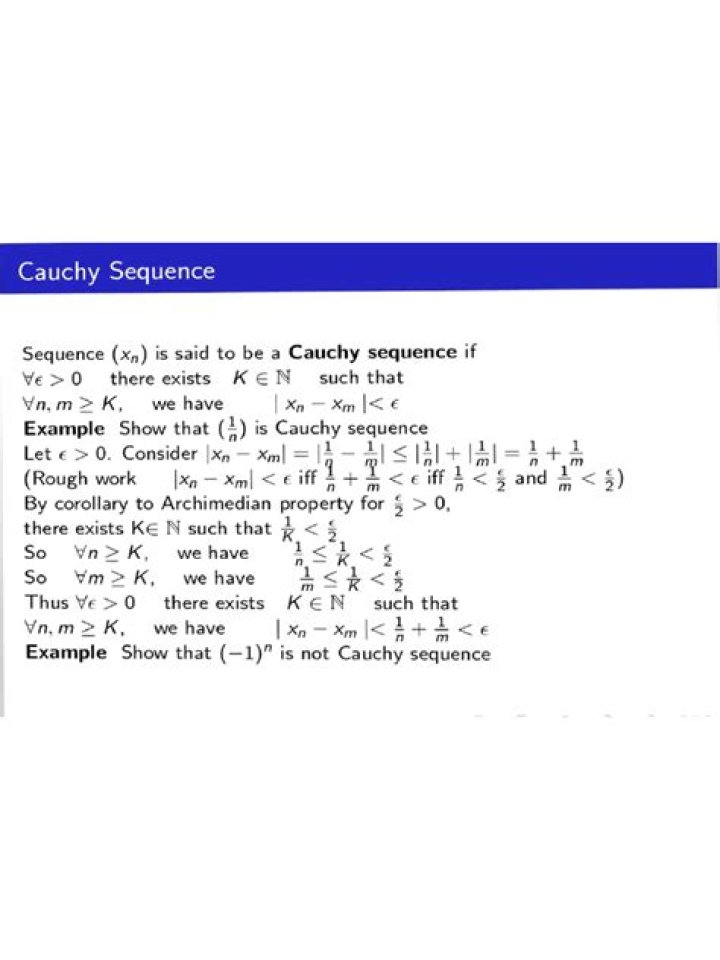
$\begingroup$As an easier example of how to apply the definition of a Cauchy sequence, define the sequence $\{\frac{1}{n}\}$. Given any $\epsilon>0$, you would like to find an $N$ such that for any $n,m>N$, $\left|\frac{1}{n}-\frac{1}{m}\right|<\epsilon$. This would certainly be the case if $\frac{1}{n},\frac{1}{m}<\frac{\epsilon}{2}$ since $\left|\frac{1}{n}-\frac{1}{m}\right|\leq\left|\frac{1}{n}\right|+\left|\frac{1}{m}\right|$. Therefore you need to force $n,m>\frac{2}{\epsilon}$. Conveniently enough, you are allowed to choose whichever $N$ you like, so choosing $N>\frac{2}{\epsilon}$ will do the trick. The above constitutes the work you do beforehand, now the proof.
Claim: The sequence $\{\frac{1}{n}\}$ is Cauchy.
Proof: Let $\epsilon>0$ be given and let $N>\frac{2}{\epsilon}$. Then for any $n,m>N$, one has $0<\frac{1}{n},\frac{1}{m}<\frac{\epsilon}{2}$. Therefore, $\epsilon>\frac{1}{n}+\frac{1}{m}=\left|\frac{1}{n}\right|+\left|\frac{1}{m}\right|\geq\left|\frac{1}{n}-\frac{1}{m}\right|$. Thus, the sequence is Cauchy as was to be shown.
$\endgroup$ 1 $\begingroup$For the particular example you chose, it is very easy to show directly that it converges to zero, because $$\sqrt{n+1} - \sqrt{n} = \frac{1}{\sqrt{n+1} + \sqrt{n}}.$$ Nevertheless, this same identity allows you to show that it is Cauchy, since $$\left|\frac{1}{\sqrt{m+1} + \sqrt{m}} - \frac{1}{\sqrt{n+1} + \sqrt{n}}\right| \leq \left| \frac{1}{2\sqrt{m}} - \frac{1}{2\sqrt{n}} \right| \leq \frac{1}{2\sqrt{\min(m,n)}}< \epsilon$$ whenever $\min(m,n) \geq N > \frac{1}{4\epsilon^2}$.
$\endgroup$