How do I Find The Chord From Only The Arc Length?
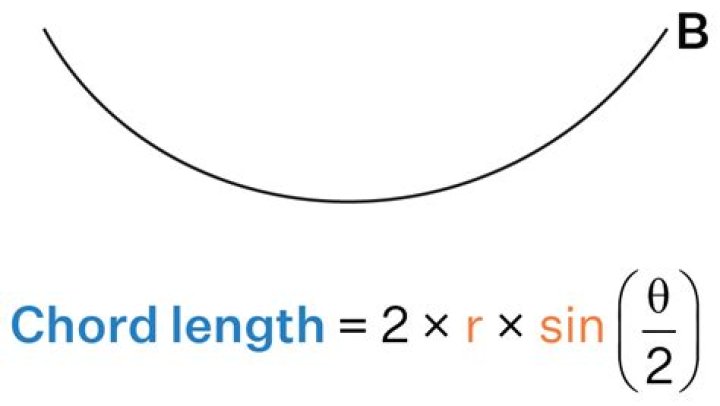
I'm trying to solve a problem where I need to find a chord and the practically only information that I've been given is the length of the arc that is defined by the chord.
Given:
- Arc Length
- Y Axis Runs through center of circle
- Location of first point on chord (0, 0)
- Y value of second point on chord
How do I find the possible X values that will result in a chord that gives the arc the specified length without resorting to trial and error methods?
$\endgroup$ 42 Answers
$\begingroup$If I understand correctly, you are given $s$ and $h$ below, and you are looking for $r$, $\theta$ and $c$.
This means solving the following equations
$$\begin{align} s &= r \theta \\ h &= r - r\cos\theta \\ c &= 2 r \sin\left( \frac{\theta}{2} \right) \end{align}$$
If you knew the radius of curvature $r$, then $$c = \frac{h}{\sin\left( \frac{s}{2 r}\right)}$$
Unfortunately, there isn't an analytical solution to the equation $$h = r -r \cos\left( \frac{s}{r} \right)$$ for $r$ in terms of $h$ and $s$.
A second order estimate, for small $\frac{h}{s}$ is $$r \approx \frac{s}{4 \sin\left( \frac{1}{3} \sin^{-1} \left( \frac{3 h}{2 s} \right) \right)}$$
This was found using a Taylor series expansion on $ \frac{h}{s} = \frac{1}{\theta} (1-\cos\theta)$
A higher order estimate is $$\frac{r}{s} \approx \frac{ \sqrt{\frac{5}{18}-\frac{\sqrt{13}}{18}}}{ \sin^{-1} \left(2 (\sqrt{13}-3) \sin \left( \frac{1}{3} \sin^{-1}\left( \frac{h}{s} \sqrt{ \frac{\sqrt{13}}{4}+1} \right) \right) \right)}$$
This last one with $\theta < \frac{\pi}{2}$ the error is less than $0.007\%$.
$\endgroup$ 3 $\begingroup$If $L$ is the arc length, $R$ the circle radius and $y$ is the ordinate of the second endpoint of chord, a simple sketch (supposing $y>0$) shows that $$ R-y=R\cos{L\over R}. $$ To compute the abscissa of the second endpoint of chord you need the value of $R$, which should then be computed from the above equation. Unfortunately, there is no easy formula for that and one has to resort to numerical methods. Not just trial and error, then, but no easy solution.
EDIT.
If we set $a=y/L$ and $t=L/R$, the above equation can be written as $$ 1-at=\cos t. $$ Finding a solution $\bar t$ of that equation is equivalent to finding the intersection between the graph of the cosine function and the line of equation $1-at$ (see diagram). That can be done iteratively, starting with some value $t_1$ and computing $t_2=\arccos(1-at_1)$, and so on.
Be warned however that for some values of $a$ you can have two solutions: the iterative procedure will give you only the smaller one.
$\endgroup$ 4