How do I convert an Arctangent into degrees by hand?
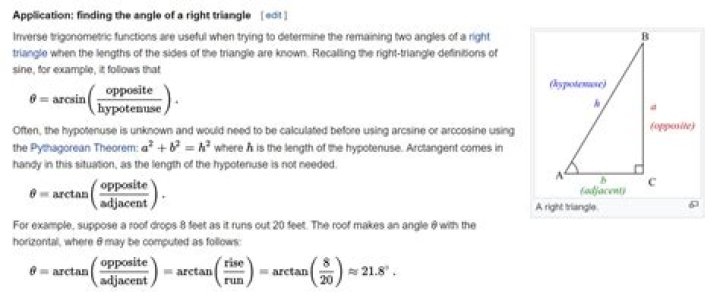
If I have $\arcsin(8/20)$, what angle is this? This is from Wikipedia and the answer is $21.8^{\circ}$. But I do not understand, by hand, how I can get the degrees.
This is from the Wikipedia page:
$8/20 = .4$
$.4$ is the ratio of rise to run, but I don't know what they did after that.
How did that get to $21.8$ degrees (or $.38$ radians)?
$\endgroup$ 72 Answers
$\begingroup$$$ \arctan(x)=x-\frac{x^3}{3}+\frac{x^5}{5}-\frac{x^7}{7}+..... $$ The point to be noted here is that this series continues on without any end. This simply means that we cannot find the exact value of the $\arctan$ of any angle in radians. Hence, we approximate.
Calculators are able to find an approximated version of the $\arctan$ by using this series. They only consider a few hundred terms of this series.
If you consider more terms, you end up with an answer closer to the actual result.
Note that for small angles the second and the consecutive terms in the series become very small and can be neglected.
In the case of your question : $$ \arctan(0.4) \approx 0.4 - \frac{(0.4)^3}{3} + \frac{(0.4)^5}{5} \\ \implies \arctan(0.4) \approx 0.38 $$
$\endgroup$ $\begingroup$Generally, you don't. When $\sin x$ is algebraic $x$ is transcendental (with x represented in radians).
That means that the solution requires working with an infinite series.
One of the easier ones is.
$\arctan x = \sum_\limits{n=0}^{\infty} \frac {(-1)^n x^{2n+1})}{2n+1}$ (With the results in radians.)
You don't usually learn this until calculus. So, if you are in trig and this seems over your head, don't worry.
$\arcsin = \arctan \frac {0.4}{\sqrt {1-0.4^2}} = \arctan \frac {2}{\sqrt {21}}$
$\arctan \frac {2}{\sqrt {21}} \approx \frac {2}{\sqrt {21}} (1-\frac {4}{63}+\frac {16}{2205}\cdots)= 0.412$
$0.38$ radians is $\arctan 0.4 = \arcsin \frac 2{\sqrt{29}}$
$\endgroup$ 1