How do I compare binary files in Linux?
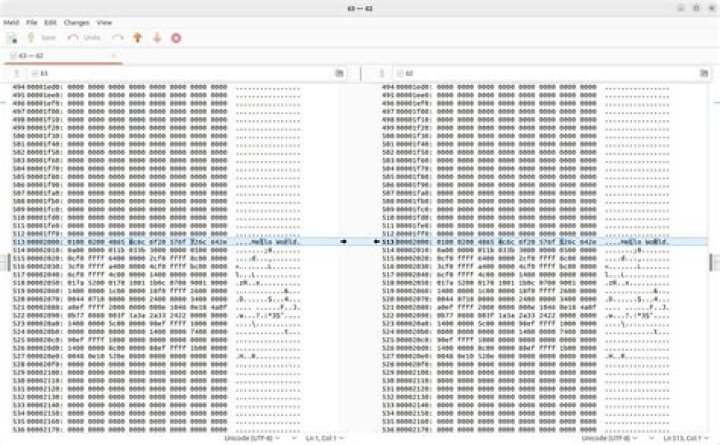
I need to compare two binary files and get the output in the form:
<fileoffset-hex> <file1-byte-hex> <file2-byte-hex>
for every different byte. So if file1.bin is
00 90 00 11in binary form and file2.bin is
00 91 00 10I want to get something like
00000001 90 91 00000003 11 10Is there a way to do this in Linux? I know about cmp -l but it uses a decimal system for offsets and octal for bytes which I would like to avoid.
17 Answers
This will print the offset and bytes in hex:
cmp -l file1.bin file2.bin | gawk '{printf "%08X %02X %02X\n", $1, strtonum(0$2), strtonum(0$3)}'Or do $1-1 to have the first printed offset start at 0.
cmp -l file1.bin file2.bin | gawk '{printf "%08X %02X %02X\n", $1-1, strtonum(0$2), strtonum(0$3)}'Unfortunately, strtonum() is specific to GAWK, so for other versions of awk—e.g., mawk—you will need to use an octal-to-decimal conversion function. For example,
cmp -l file1.bin file2.bin | mawk 'function oct2dec(oct, dec) {for (i = 1; i <= length(oct); i++) {dec *= 8; dec += substr(oct, i, 1)}; return dec} {printf "%08X %02X %02X\n", $1, oct2dec($2), oct2dec($3)}'Broken out for readability:
cmp -l file1.bin file2.bin | mawk 'function oct2dec(oct, dec) { for (i = 1; i <= length(oct); i++) { dec *= 8; dec += substr(oct, i, 1) }; return dec } { printf "%08X %02X %02X\n", $1, oct2dec($2), oct2dec($3) }'As ~quack pointed out:
% xxd b1 > b1.hex % xxd b2 > b2.hexAnd then
% diff b1.hex b2.hexor
% vimdiff b1.hex b2.hexdiff + xxd
Try diff in the following combination of zsh/bash process substitution:
diff -y <(xxd foo1.bin) <(xxd foo2.bin)Where:
-yshows you differences side-by-side (optional).xxdis CLI tool to create a hexdump output of the binary file.- Add
-W200todifffor wider output (of 200 characters per line). - For colors, use
colordiffas shown below.
colordiff + xxd
If you've colordiff, it can colorize diff output, e.g.:
colordiff -y <(xxd foo1.bin) <(xxd foo2.bin)Otherwise install via: sudo apt-get install colordiff.
Sample output:
vimdiff + xxd
You can also use vimdiff, e.g.
vimdiff <(xxd foo1.bin) <(xxd foo2.bin)Hints:
- if files are too big, add limit (e.g.
-l1000) for eachxxd
There's a tool called DHEX which may do the job, and there's another tool called VBinDiff.
For a strictly command-line approach, try jojodiff.
9Method that works for byte addition / deletion
diff <(od -An -tx1 -w1 -v file1) \ <(od -An -tx1 -w1 -v file2)Generate a test case with a single removal of byte 64:
for i in `seq 128`; do printf "%02x" "$i"; done | xxd -r -p > file1
for i in `seq 128`; do if [ "$i" -ne 64 ]; then printf "%02x" $i; fi; done | xxd -r -p > file2
Output:
64d63
< 40
If you also want to see the ASCII version of the character:
bdiff() ( f() ( od -An -tx1c -w1 -v "$1" | paste -d '' - - ) diff <(f "$1") <(f "$2")
)
bdiff file1 file2
Output:
64d63
< 40 @
Tested on Ubuntu 16.04.
I prefer od over xxd because:
- it is POSIX,
xxdis not (comes with Vim) - has the
-Anto remove the address column withoutawk.
Command explanation:
-Anremoves the address column. This is important otherwise all lines would differ after a byte addition / removal.-w1puts one byte per line, so that diff can consume it. It is crucial to have one byte per line, or else every line after a deletion would become out of phase and differ. Unfortunately, this is not POSIX, but present in GNU.-tx1is the representation you want, change to any possible value, as long as you keep 1 byte per line.-vprevents asterisk repetition abbreviation*which might interfere with the diffpaste -d '' - -joins every two lines. We need it because the hex and ASCII go into separate adjacent lines. Taken from:- we use parenthesis
()to definebdiffinstead of{}to limit the scope of the inner functionf, see also:
See also:
1Short answer
vimdiff <(xxd -c1 -p first.bin) <(xxd -c1 -p second.bin)When using hexdumps and text diff to compare binary files, especially xxd, the additions and removals of bytes become shifts in addressing which might make it difficult to see. This method tells xxd to not output addresses, and to output only one byte per line, which in turn shows exactly which bytes were changed, added, or removed. You can find the addresses later by searching for the interesting sequences of bytes in a more "normal" hexdump (output of xxd first.bin).
I'd recommend hexdump for dumping binary files to textual format and kdiff3 for diff viewing.
hexdump myfile1.bin > myfile1.hex
hexdump myfile2.bin > myfile2.hex
kdiff3 myfile1.hex myfile2.hexThe hexdiff is a program designed to do exactly what you're looking for.
Usage:
hexdiff file1 file2It displays the hex (and 7-bit ASCII) of the two files one above the other, with any differences highlighted. Look at man hexdiff for the commands to move around in the file, and a simple q will quit.
The firmware analysis tool binwalk also has this as a feature through its -W/--hexdump command line option which offers options such as to only show the differing bytes:
-W, --hexdump Perform a hexdump / diff of a file or files -G, --green Only show lines containing bytes that are the same among all files -i, --red Only show lines containing bytes that are different among all files -U, --blue Only show lines containing bytes that are different among some files -w, --terse Diff all files, but only display a hex dump of the first fileIn OP's example when doing binwalk -W file1.bin file2.bin:
Add | less -r for paging.
It may not strictly answer the question, but I use this for diffing binaries:
gvim -d <(xxd -c 1 ~/file1.bin | awk '{print $2, $3}') <(xxd -c 1 ~/file2.bin | awk '{print $2, $3}')It prints both files out as hex and ASCII values, one byte per line, and then uses Vim's diff facility to render them visually.
2dhex
DHEX is a more than just another hex editor: It includes a diff mode, which can be used to easily and conveniently compare two binary files. Since it is based on ncurses and is themeable, it can run on any number of systems and scenarios. With its utilization of search logs, it is possible to track changes in different iterations of files easily.
4Below is a Perl script, colorbindiff, which performs a binary diff, taking into account bytes changes but also byte additions/deletions (many of the solutions proposed here only handle byte changes), like in a text diff. It's also available on GitHub.
It displays results side by side with colors, and this greatly facilitate analysis.
To use it:
perl colorbindiff.pl FILE1 FILE2The script:
#!/usr/bin/perl
#########################################################################
#
# VBINDIFF.PL : A side-by-side visual diff for binary files.
# Consult usage subroutine below for help.
#
# Copyright (C) 2020 Jerome Lelasseux
#
# This program is free software: you can redistribute it and/or modify
# it under the terms of the GNU General Public License as published by
# the Free Software Foundation, either version 3 of the License, or
# (at your option) any later version.
#
# This program is distributed in the hope that it will be useful,
# but WITHOUT ANY WARRANTY; without even the implied warranty of
# MERCHANTABILITY or FITNESS FOR A PARTICULAR PURPOSE. See the
# GNU General Public License for more details.
#
# You should have received a copy of the GNU General Public License
# along with this program. If not, see <
#
#
#########################################################################
use warnings;
use strict;
use Term::ANSIColor qw(colorstrip colored);
use Getopt::Long qw(GetOptions);
use File::Temp qw(tempfile);
use constant BLANK => "..";
use constant BUFSIZE => 64 * 1024; # 64kB
sub usage
{ print "USAGE: $0 [OPTIONS] FILE1 FILE2\n"; print "Show a side-by-side binary comparison of FILE1 and FILE2. Show byte modifications but also additions and deletions, whatever the number of changed bytes. Rely on the 'diff' external command such as found on Linux or Cygwin. The algorithm is not suited for large and very different files.\n"; print "Author: Jerome Lelasseux \@2021\n"; print "OPTIONS: \n"; print " --cols=N : display N columns of bytes.diff Default is 16.\n"; print " --no-color : don't colorize output. Needed if you view the output in an editor.\n"; print " --no-marker : don't use the change markers (+ for addition, - for deletion, * for modified).\n"; print " --no-ascii : don't show the ascii columns.\n"; print " --only-changes : only display lines with changes.\n"; exit;
}
# Command line arguments
my $maxCols = 16;
my $noColor = 0;
my $noMarker = 0;
my $noAscii = 0;
my $noCommon = 0;
GetOptions( 'cols=i' => \$maxCols, 'no-ascii' => \$noAscii, 'no-color' => \$noColor, 'no-marker' => \$noMarker, 'only-changes' => \$noCommon
) or usage();
usage() unless ($#ARGV == 1);
my ($file1, $file2) = (@ARGV);
# Convert input files into hex lists
my $fileHex1 = createHexListFile($file1);
my $fileHex2 = createHexListFile($file2);
# Process diff -y output to get an easy-to-read side-by-side view
my $colIndex = 0;
my $oldPtr = 0;
my $newPtr = 0;
my $oldLineBuffer = sprintf("0x%04X ", 0);
my $newLineBuffer = sprintf("0x%04X ", 0);
my $oldCharBuffer;
my $newCharBuffer;
my $isDeleting = 0;
my $isAdding = 0;
my $isUnchangedLine = 1;
open(my $fh, '-|', qq(diff -y $fileHex1 $fileHex2)) or die $!;
while (<$fh>)
{ # Parse line by line the output of the 'diff -y' on the 2 hex list files. # We expect: # "xx | yy" for a modified byte # " > yy" for an added byte # "xx <" for a deleted byte # "xx xx" for identicial bytes my ($oldByte, $newByte); my ($oldChar, $newChar); if (/\|/) { # Changed if ($isDeleting || $isAdding) { printLine($colIndex); } $isAdding = 0; $isDeleting = 0; $isUnchangedLine = 0; /([a-fA-F0-9]+)([^a-fA-F0-9]+)([a-fA-F0-9]+)/; $oldByte = formatByte($1, 3); $oldChar = toPrintableChar($1, 3); $newByte = formatByte($3, 3); $newChar = toPrintableChar($3, 3); $oldPtr++; $newPtr++; } elsif (/</) { # Deleted in new if ($isAdding) { printLine($colIndex); } $isAdding = 0; $isDeleting = 1; $isUnchangedLine = 0; /([a-fA-F0-9]+)/; $oldByte=formatByte($1, 2); $oldChar=toPrintableChar($1, 2); $newByte=formatByte(BLANK, 2); $newChar=colorize(".", 2); $oldPtr++; } elsif (/>/) { # Added in new if ($isDeleting) { printLine($colIndex); } $isAdding = 1; $isDeleting = 0; $isUnchangedLine = 0; /([a-fA-F0-9]+)/; $oldByte=formatByte(BLANK, 1); $oldChar=colorize(".", 1); $newByte=formatByte($1, 1); $newChar=toPrintableChar($1, 1); $newPtr++; } else { # Unchanged if ($isDeleting || $isAdding) { printLine($colIndex); } $isDeleting = 0; $isAdding = 0; /([a-fA-F0-9]+)([^a-fA-F0-9]+)([a-fA-F0-9]+)/; $oldByte=formatByte($1, 0); $oldChar=toPrintableChar($1, 0); $newByte=formatByte($3, 0); $newChar=toPrintableChar($3, 0); $oldPtr++; $newPtr++; } # Append the bytes to the old and new buffers $oldLineBuffer .= $oldByte; $oldCharBuffer .= $oldChar; $newLineBuffer .= $newByte; $newCharBuffer .= $newChar; $colIndex++; if ($colIndex == $maxCols) { printLine(); }
}
printLine($colIndex); # Possible remaining line
#================================================================
# subroutines
#================================================================
# $1 a string representing a data byte
# $2 0=unchanged, 1=added, 2=deleted, 3=changed
# return the formatted string (color/maker)
sub formatByte
{ my ($byte, $type) = @_; my $res; if (!$noMarker) { if ($type == 0 || $byte eq BLANK) { $res = " " . $byte; } # Unchanged or blank elsif ($type == 1) { $res = " +" . $byte; } # Added elsif ($type == 2) { $res = " -" . $byte; } # Deleted elsif ($type == 3) { $res = " *" . $byte; } # Changed else { die "Error"; } } else { $res = " " . $byte; } $res = colorize($res, $type); return $res;
}
# $1 a string
# $2 0=unchanged, 1=added, 2=deleted, 3=changed
# return the colorized string according to $2
sub colorize
{ my ($res, $type) = @_; if (!$noColor) { if ($type == 0) { } # Unchanged elsif ($type == 1) { $res = colored($res, 'bright_green'); } # Added elsif ($type == 2) { $res = colored($res, 'bright_red'); } # Deleted elsif ($type == 3) { $res = colored($res, 'bright_cyan'); } # Changed else { die "Error"; } } return $res;
}
# Print the buffered line
sub printLine
{ if (length($oldLineBuffer) <=10) { return; # No data to display } if (!$isUnchangedLine) { # Colorize and add a marker to the address of each line if some bytes are changed/added/deleted my $prefix = substr($oldLineBuffer, 0, 6) . ($noMarker ? " " : "*"); $prefix = colored($prefix, 'magenta') unless $noColor; $oldLineBuffer =~ s/^......./$prefix/; $prefix = substr($newLineBuffer, 0, 6) . ($noMarker ? " " : "*"); $prefix = colored($prefix, 'magenta') unless $noColor; $newLineBuffer =~ s/^......./$prefix/; } my $oldCBuf = $noAscii ? "" : $oldCharBuffer; my $newCBuf = $noAscii ? "" : $newCharBuffer; my $spacerChars = $noAscii ? "" : (" " x ($maxCols - $colIndex)); my $spacerData = ($noMarker ? " " : " ") x ($maxCols - $colIndex); if (!($noCommon && $isUnchangedLine)) { print "${oldLineBuffer}${spacerData} ${oldCBuf}${spacerChars} ${newLineBuffer}${spacerData} ${newCBuf}\n"; } # Reset buffers and counters $oldLineBuffer = sprintf("0x%04X ", $oldPtr); $newLineBuffer = sprintf("0x%04X ", $newPtr); $oldCharBuffer = ""; $newCharBuffer = ""; $colIndex = 0; $isUnchangedLine = 1;
}
# Convert a hex byte string into a printable char, or '.'.
# $1 = hex str such as A0
# $2 0=unchanged, 1=added, 2=deleted, 3=changed
# Return the corresponding char, possibly colorized
sub toPrintableChar
{ my ($hexByte, $type) = @_; my $char = chr(hex($hexByte)); $char = ($char =~ /[[:print:]]/) ? $char : "."; return colorize($char, $type);
}
# Convert file $1 into a text file with 1 hex byte per line.
# $1=input file name
# Return the output file name
sub createHexListFile
{ my ($inFileName) = @_; my $buffer; my $in_fh; open($in_fh, "<:raw", $inFileName) || die "$0: cannot open $inFileName for reading: $!"; my ($out_fh, $filename) = tempfile(); while (my $nbReadBytes = read($in_fh, $buffer, BUFSIZE)) { my @hexBytes = unpack("H2" x $nbReadBytes, $buffer); foreach my $hexByte (@hexBytes) { print $out_fh "$hexByte\n" || die "couldn't write to $out_fh: $!"; } } close($in_fh); return $filename;
}
You can use the gvimdiff tool that is included in the vim-gui-common package
sudo apt-get update
sudo apt-get install vim-gui-common
Then you can compare two hexadecimal files using the following commands:
ubuntu> gvimdiff <hex-file1> <hex-file2>I wrote a simple script to diff a binary file. It will print the first different chunk (40 bytes) and offset:
$ bindiff file1 file2
8880> 442408E868330300488D05825337004889042448C744240802000000E84F330300E88A2A0300488B ^^^^^^^^^ ^^ 442408E868330300E59388E59388004889042448C744240802000000E84F330300E88A2A0300488B
Here is a script to use kdiff3 on hex output:
#!/bin/bash
mkdir -p ~/tmp/kdiff3/a
mkdir -p ~/tmp/kdiff3/b
a="$HOME/tmp/kdiff3/a/`basename $1`.hex"
b="$HOME/tmp/kdiff3/b/`basename $2`.hex"
xxd "$1" > "$a"
xxd "$2" > "$b"
kdiff3 "$a" "$b"
Which you could save as e.g. kdiff3bin and use like:
kdiff3bin file1.bin file2.binBinDiff is a great UI tool for comparing binary files that has been open sourced recently.
1The go to open source product on Linux (and everything else) is Radare which provides radiff2 explicitly for this purpose.
for every different byte
That's insane though. Because as asked, if you insert one byte at the first byte in the file, you'd find every subsequent byte was different and so the diff would repeat the whole file, for an actual difference of one byte.
Slightly more practical is radiff -O. The -O is for ""Do code diffing with all bytes instead of just the fixed opcode bytes""
0x000000a4 0c01 => 3802 0x000000a4
0x000000a8 1401 => 3802 0x000000a8
0x000000ac 06 => 05 0x000000ac
0x000000b4 02 => 01 0x000000b4
0x000000b8 4c05 => 0020 0x000000b8
0x000000bc 4c95 => 00a0 0x000000bc
0x000000c0 4c95 => 00a0 0x000000c0
Like IDA Pro, Radare is a tool primary for binary analysis, and you can also show delta diffing with -d, or display the disassembled bytes instead of hex with -D.
See also: