How can I show that two sets are equal? Please check my answers.
How can I show that two sets are equal?
I haven't learned any set theory outside of what is required for linear algebra. As such, I was wondering if someone could please take the time to check my answers:
Show that the intersection of the two sets is equal to both of the individual sets.
Show that the subtraction of the two sets is equal to the empty set.
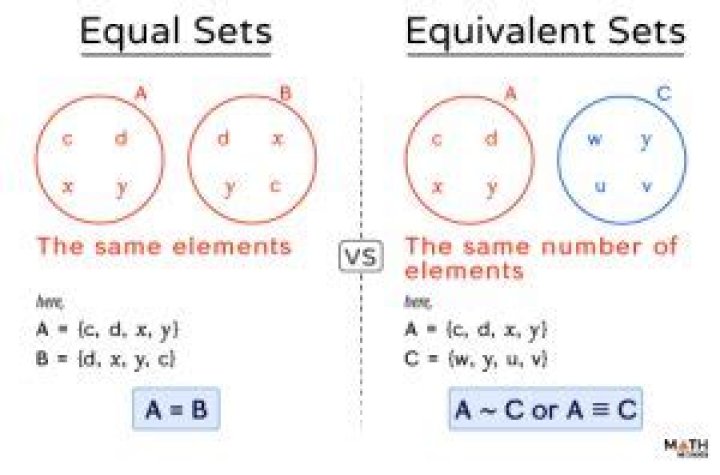
Show that the two sets contain the same elements.
Thank you.
$\endgroup$ 52 Answers
$\begingroup$In set theory (specifically ZF) it is an axiom that (informally) if two sets have the same elements, then they are equal (this is the Axiom of extensionality).
So from a set theory viewpoint, we are ultimately trying to show what you label as (3). You could say that this is pretty much the definition of what we mean when we say '$A = B$' when $A$ and $B$ are sets.
Given that understanding, in addition to (1) and (2) (with the latter amended for clarity to be 'symmetric difference' as Gaffney noted), one could also add: $A = B$ if $A$ is a subset of $B$ and $B$ is a subset of $A$.
A useful exercise for you might be to show that each technique yields the desired result: $(\forall z: z\in A \iff z \in B) \implies A = B$.
$\endgroup$ $\begingroup$(1) and (3) in the question are fine, but (2) really isn't. As @ChasBrown and @Gaffney mentioned, you need to replace subtraction there to symmetric difference. But it's not just a matter of avoiding ambiguity:
Presumably subtracting a set $B$ from a set $A$ is intended to mean $A-B,$ which is $\{x \mid x\in A\text{ and }x\not\in B\}.$ But if $\,A-B=\emptyset,\,$ all you can conclude is that $A\subseteq B.$
If you do replace $A-B$ with the symmetric difference $A\Delta B,$ which is $(A-B)\cup(B-A),$ then it's true that $A\Delta B=\emptyset$ implies $A=B.$ (But nobody would call this operation subtraction.)
One comment on the notation I used: I wrote $\,A-B\,$ since that notation seems more in keeping with referring to the operation in question as "subtraction"; however, the notation $\,A\setminus B\,$ has become more common in recent years. [I'm not quite sure why; it feels more awkward to me, but nevertheless $\,A\setminus B\,$ appears to have nearly supplanted $\,A-B.]$
$\endgroup$ 1