How can I flip the signs of this denominator without affecting the rest of the equation?
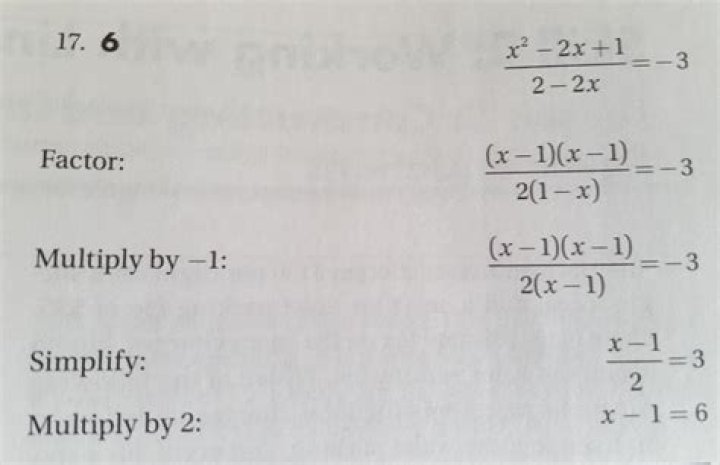
I am trying to solve an equation for x and I seem to be making a mistake in how I multiply by -1. First I simplified the equation to:
$$\frac{(x-1)(x-1)}{2(1-x)} = -3$$
I changed the order of the denominator to $2(-x+1)$. I then multiplied both sides of the equation by -1, or $\frac{-1}{1}$, to get:
$$\frac{(-x+1)(-x+1)}{2(-x+1)} = 3$$
This then simplifies to $-5$, but the correct answer is $7$.
The book appears to arrive at the same simplification at the top of the post, but then takes a different route to solving that I can't wrap my head around.
The book goes from:
$$\frac{(x-1)(x-1)}{2(1-x)} = -3$$
To:
$$\frac{(x-1)(x-1)}{2(x-1)} = -3$$
How were they able to simply flip the signs in the $(1-x)$ of the denominator seemingly without affecting any other part of the equation? If you multiply by $-1$ wouldn't that mean $-3$ would become $+3$? I used to do equations like this automatically when I was in school, now I feel lost!
Edit: Here is an actual image of the textbook's problem & steps:
2 Answers
$\begingroup$When you multiply a product by $\;-1\;$ you must only multiply one factor, not both. In your case it is simpler: just "take out" the minus sign from the denominator: $\;2(1-x)=-2(x-1)\;$:
$$\frac{(x-1)(x-1)}{2(1-x)}=-3\implies -\frac{(x-1)(x-1)}{2(x-1)}=-3\implies$$
$$\implies\frac{x-1}2=3\implies \color{red}{x=7}$$
$\endgroup$ 4 $\begingroup$In your problem you start with $$\frac{(x-1)(x-1)}{2(1-x)}=-3$$
Note that $(x-1)(x-1)=(-x+1)(-x+1)$, since
$$(x-1)(x-1)=(-1)(-x+1)(-1)(-x+1)$$
so you never multiplied your left hand side by $-1$...
$\endgroup$ 5