How can I find the area of the region bounded by the hyperbola
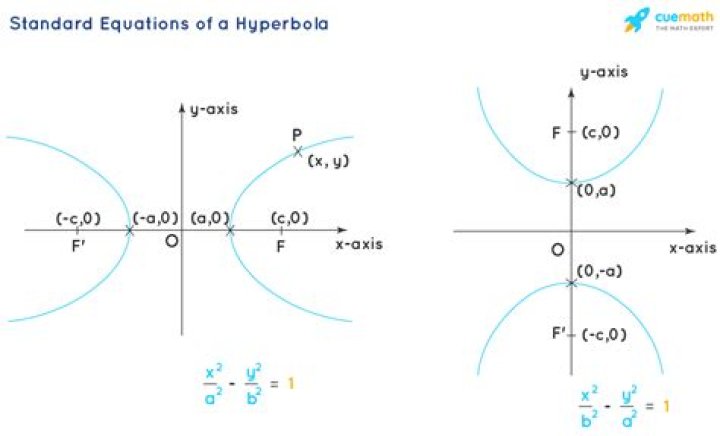
now I got region question.... The question was "find the area of the region bounded by the hyperbola $9x^{2} - 4y^{2} = 36$ and the line $x = 3$
I drew the graph of $9x^{2} - 4y^{2} = 36$ and $x = 3$ and I got right side is bounded by $x=3$ but since the graph is hyperbola, left side is not bounded by anything. My question is that how I can find the area of the region ?
If you have any idea, could post here ? Thanks !!
$\endgroup$ 13 Answers
$\begingroup$Solving for $y$ produces:
$$ y =\frac{1}{2} \sqrt{9x^2-36} $$
What we need to find is the area of $y$ from $x=2$ to $x=3$.
Thus we put:
$$A = \frac{1}{2}\int_2^3 \sqrt{9x^2-36} dx$$
Make an "hiperbolic" substitution:
$$3x = 6 \cosh u$$
$$3dx = 6 \sinh u du$$
We get the new limits are $0$ and $b = \cosh^{-1}\frac{3}{2} = \log({\frac{3}{2} +\sqrt{\frac{5}{4}}})$
$$A = 6\int_0^b {{{\sinh }^2}udu} $$
This integral is very similar to the integral of $\sin^2 x$,
$$A = 6\int_0^b {{{\sinh }^2}udu} =6 \left. {\frac{{\sinh \left( {2u} \right) - 2u}}{4}} \right|_0^b$$
Then you have
$$A = 3\frac{{\sinh 2b - 2b}}{2}$$
After a myriad of algebraic steps I end up with
$$A = \frac{9}{4}\sqrt 5 - 6\log \phi $$
Where $$\phi$$ is the golden ratio number.
Note that
$$\eqalign{ & \log 8 - 3\log \left( {3 + \sqrt 5 } \right) = 3\log 2 - 3\log \left( {3 + \sqrt 5 } \right) = \cr & - 3\log \left( {\frac{{3 + \sqrt 5 }}{2}} \right) = - 3\log \left( {1 + \frac{{1 + \sqrt 5 }}{2}} \right) = \cr & - 3\log \left( {1 + \phi } \right) = - 3\log {\phi ^2} = - 6\log \phi \cr} $$
EDIT: Remeber the value is just half the value of the total area.
$\endgroup$ $\begingroup$If you take a look below, the left side is actually the hyperbola itself (specifically the right branch).
I assume you can proceed as follows:
We need to use bound integration between 2 points like this:
$\int_{x_1}^{x_2} f(x) dx$
Since,
$9x^{2} - 4y^{2} = 36$
We can write:
$f(x)=y=\sqrt{(36-9x^2)/-4}$
Next, we need to find $x_1$, from the diagram, this value is 2.
Next, find $x_2$, this is the value 3.
Note that the values 2, 3 above are used as bounds because this represents a finite area. Negative values of $x$ are excluded since the function does not intersect with x=3 for those values.
So, now the area A is defined by:
A = $\int_{x_1}^{x_2} f(x) dx$ = $\int_{2}^{3} (\sqrt{(36-9x^2)/-4}) dx$