How can I check the version of Google Chrome without it upgrading itself without asking me?
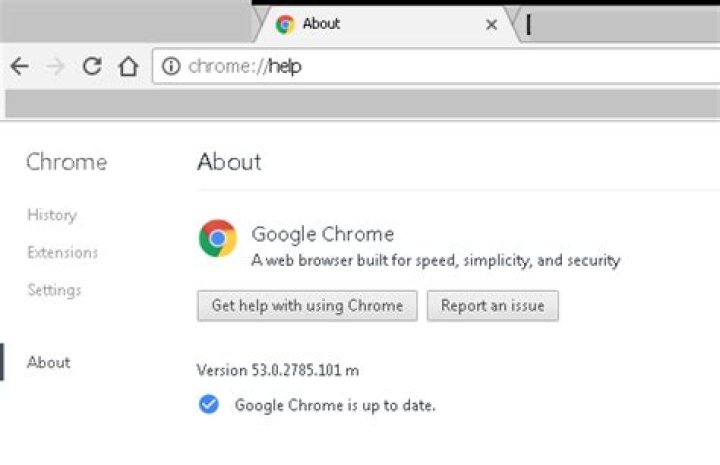
The version of Google Chrome can be checked by going to chrome://help. However, if Google Chrome is not up to date, it will upgrade itself without asking the user. How can I check the version of Google Chrome without it upgrading itself without asking me?
I use Google Chrome on Windows 7 SP1 x64 Ultimate.
87 Answers
How can I check the version of Google Chrome without it upgrading itself without asking me?
Below are some possibilities.
Type chrome://version in the Chrome address bar
The version number will be displayed:
Check using "Programs and Features"
In the "Start" menu of Windows select "Control Panel" then select "Programs and Features".
The version number will be displayed in the last column:
Turn off Google Update, then type chrome://version in the Chrome address bar
To check for the update, Google Chrome uses two System Services namely Google Update (
gupdate) and Google Update (gupdatem). So, to turn off automatic update in Google Chrome, we have to disable these Google services.You can disable these services easily from the System Configuration window. Follow these steps to know how to turn off automatic updates in Google Chrome.
Note: Turning off auto-updates should be done with caution. You may not receive the latest security updates if you do not auto-update or manually update Google Chrome frequently.
Close the Google Chrome browser. Make sure you save all open tabs in Chrome if you want to restore them later.
Press WindowsR. It will open the "Run command" dialogue box.
Type, "msconfig" in the box and press enter. It will open the "System Configuration" Window.
In the "System Configuration" window, select the "Services" tab.
At the bottom, check the box "Hide All Microsoft Services". This will hide all the services related to Microsoft so that you don’t disable essential services.
Under services section search and find "Google Update (gupdate)" and "Google Update (gupdatem)".
Uncheck both the Google Services and click "Apply". Click "OK" to save the settings.
Now, you will be asked whether you want to exit without restart or want to restart your PC now. Choose anything according to your current situation.
That’s it! You have successfully disabled automatic updates in Google Chrome.
To check whether the settings have been applied correctly, open Google Chrome > click "Chrome Menu" > "Help" > "About Google Chrome".
Now Google Chrome will start checking for the available update. If you see an "An error occurred while checking for updates: Update check failed to start (error code 3: 0x800704C7 — system level)." message then you have successfully disabled the automatic updates in Google Chrome.
Note:
When you open Google Chrome next time, you might be asked to provide administrative access to enable automatic update in Google Chrome. Simply select "No" every time.
Source Disable Automatic Updates in Google Chrome
1You can also consult the properties of the Chrome executable. (This works even if Chrome isn't running.) To find that file, choose Open file location in the context menu of Chrome's Start menu entry, then right-click the shortcut you get and choose the same option. For me, the main Chrome program is here:
C:\Program Files (x86)\Google\Chrome\Application\chrome.exeRight-click that file and choose Properties. On the Details tab, there is a Product version row, which contains the Chrome version.
If Chrome is running, there's another way if you like consoles: You can use PowerShell!
(Get-Process 'chrome').MainModule[0].ProductVersionThat prints the product version of a Chrome process's main module (chrome.exe) to the standard output. You'll get the same value as you do in the above screenshot.
Just type this into the address bar:
javascript:alert(navigator.userAgent)Note: Type, don't paste - if you paste, the browser removes the javascript: part automatically, and then it does not work.
The easiest way is to go to whatismybrowser.com which will show you your version number (scroll down to see the full version). It will also tell you if it's the latest version - without chrome dialing home to Google's servers.
1Another effective (and default) way to prevent the auto-update is to set the User Account Control (UAC) settings' bar to the highest level in your Windows machine. On Windows 7:
You can open the dialog by going to Control Panel, clicking User Accounts, and then clicking Change User Account Control Settings (MS TechNet).
Normally this is the default level:
Drag that bar up to the top and click OK:
Now when you access chrome://help a pop-up will show up asking if you want to give write permissions to Chrome. If you click No, the update will not be performed.
You may access chrome://version later to confirm it.
Note: having UAC set to the highest level is recommended in terms of system security, especially because it does not allow most programs to perform write operations without your confirmation (e.g. when you download a .ppt from an email with cute kittens that has some embedded macros, it will prevent those macros to be run without your authorization).
You may wish to turn off Google Update services. This may help.
5You can check google chrome's version from the command line, I'm using chromium (The open-source project providing the code for Google Chrome) on a Debian distro, I can type chromium --version, I get this :
Chromium 49.0.2623.87 built on Debian stretch/sid, running on Debian Kali
Linux Rolling
the version in my case is : 49.0.2623.87
In your case, you're using Windows, look for CMD commands to do the same.