How can a negative multiplied by a negative give positive? [duplicate]
On first look this can seem weird. But I can explain what I am looking for.
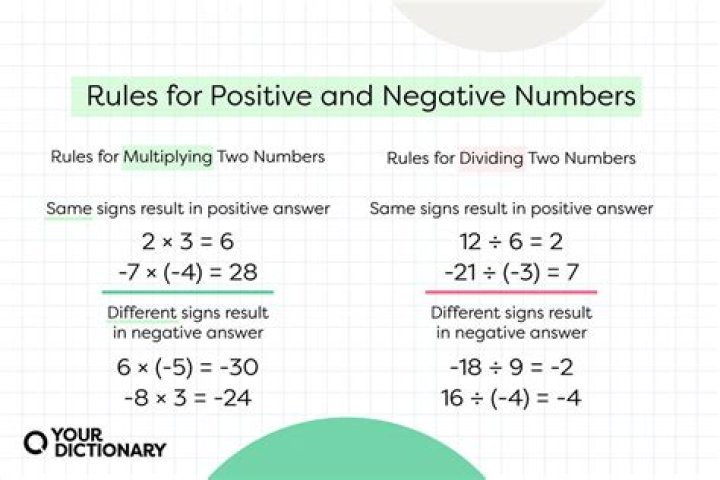
We all know from elementary maths that $(-\times-)=+$.
Now, lets say there are 3 cows and I say they will become doubled after one year so $3*2=6$.
And lets say I have $-3$ cows(which is not possible, because I can show $3$ cows but not $-3$) and if I multiply it by $-2$, I get $-3\times -2=6$. How is it possible?, nothing multiplied by nothing equals something?
Some said the reason belongs to philosophy, if yes, what's the idea behind it?
$\endgroup$ 72 Answers
$\begingroup$It's best to think, perhaps, of the negative sign as a "change in direction". The default direction is to the positive end of the number line (to the right). So $3\times 2$ moves us six units to the right, to land at $6$.
$-3\times 2$ changes direction and moves us $6$ units to the left of zero, to land at $-6$.
$-3 \times -2 = -(-3 \times 2)$ reverses our direction once again, taking us back to the right six units from zero, the opposite direction than does $-3 \times 2$ in the amount of $6$ units to the right. So in the end, we are at the "same position" whether we use $3\times 2$ or $-3\times -2$.
Note that our use of arithmetic, in a practical sense, depends on the context in which we are applying it. So your example is just a poor context to apply multiplication of negative numbers, since, of course, it seems absurd to think of having $-3$ cows. But negative numbers can represent position, with respect to some point of origin, as I noted in the number line example above. And time can be represented in terms of the past (negative time), now (the point of reference), and the future (positive values for time). Similarly, in finance, negative numbers can represent debt or loss, while positive numbers represent profit, or gain. I'm sure if you put your thinking cap on, you'll see that mutltiplication of negative numbers certainly can, and does make sense.
$\endgroup$ 2 $\begingroup$Multiplication by a positive number is rather intuitive, so $(+ \times +)$ and $(+\times -)$ are relatively easy (for the latter, think you multiply a debt, for example). So the hard one is $(- \times -)$. I may be uneasy to understand this directly, but if you want to keep laws of arithmetic as they are with positive numbers, then
$$a \times (b + c) = a \times b + a \times c$$
With $c=-b$, it yields
$$0 = a \times 0 = a \times b + a \times (-b)$$ $$a \times b = - (a \times (-b))$$
Now, if both $a$ and $b$ are negative, you must have on the left $(- \times -)$, and on the right, the negation of $(- \times +)$, thus a positive number.
$\endgroup$