How are the average rate of change and the instantaneous rate of change related for ƒ(x) = 2x + 5?
How are the average rate of change and the instantaneous rate of change related for ƒ(x) = 2x + 5 ?
Should I figure out what is similar between them to solve this question? I don't understand how they correlate
$\endgroup$ 31 Answer
$\begingroup$The average rate of change is defined as:
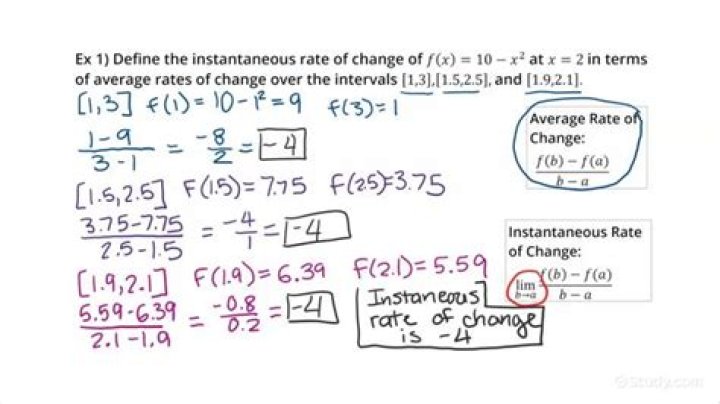
$r_{avg} = \frac{f(b)-f(a)}{b-a}$, over some interval $[a,b]$.
The instantaneous rate of change is defined as the slope of $f$ evaluated at a single point, e.g.: $f'(c)$ where $c$ is a predefined point.
In this case, because $f(x)=2x+5$, we have:
$r_{avg}=\frac{(2b+5)-(2a+5)}{b-a}$=$\frac{2b-2a}{b-a}$=$2$
And you will also note notice that the slope of $f(x)$ is...$2$!
Addendum:
The reason that the average rate of change equals the instantaneous is because the slope is constant in this function.
In general, instantaneous change is defined as the derivative of the function evaluated at a single point.
The average change is the same as always (pick two points, and divide the difference in the function values by the difference in the $x$ values).
But, if the curve looks like $y=x^2$, this won't be the case. The slope at a single point anywhere along the curve is different, and the average rate of change will not always be the same as the instantaneous, though it can for certain points. (See "Mean Value Theorem")
$\endgroup$