Horizontal Asymptote rules
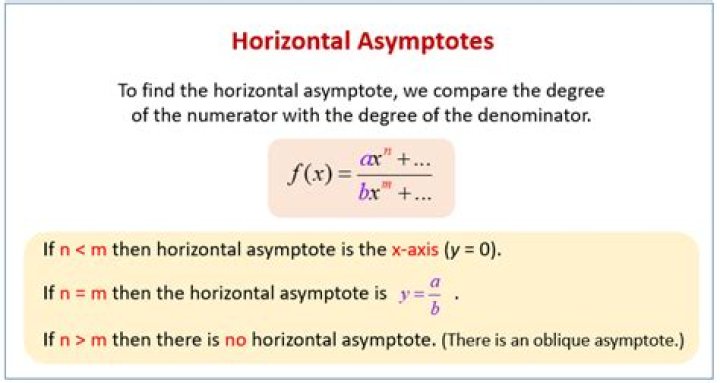
If I understand it correctly, one of the rules for double checking your answer when finding a Horizontal Asymptote using limits is: If the degree of the numerator is > the degree of the denominator, there is no HA
When finding the limit as $x$ goes to infinity of this equation, however, the HA works out to $y=\frac{1}{6}$: $$\sqrt{9x^2 + x} - 3x$$ Any ideas on what I'm missing? Why am I able to work it out to HA is $y=\frac 1 6$, when there should technically be no HA?
$\endgroup$ 12 Answers
$\begingroup$The rule about degrees of the numerator and denominator applies when those are polynomial functions. But polynomial functions are not what you've got here. Right the whole expression over $1$, then rationalize the numerator, then simplify, then in the denominator write $\sqrt{9x^2+x} = \sqrt{9x^2}\sqrt{1+\frac{1}{9x}}$. Notice that $\sqrt{9x^2}=3x$ if $x>0$, and $=-3x$ if $x<0$.
$\endgroup$ $\begingroup$With respect to asymptotic behavior, you can go one step further. After writing, as suggested by Michael Hardy,$$y=\sqrt{9x^2+x}-3x = \sqrt{9x^2}\sqrt{1+\frac{1}{9x}}-3x= 3x\sqrt{1+\frac{1}{9x}}-3x$$, you can take into account that, when $z$ is small $\sqrt{1+z}$ can be approximated (Taylor series limited to the second order) by $1+\frac{z}{2}-\frac{z^2}{8}+O\left(z^3\right)$. So, replacing $z$ by $\frac{1}{9 x}$ in the previous expression leads to $$y=\frac{1}{6}-\frac{1}{216 x}+O\left(\left(\frac{1}{x}\right)^2\right)$$ So, the asymptote is $\frac{1}{6}$ and the curve is below the asymptote (just because of the sign of the term $\frac{1}{x}$)
$\endgroup$