History of the power of a point with respect to a circle
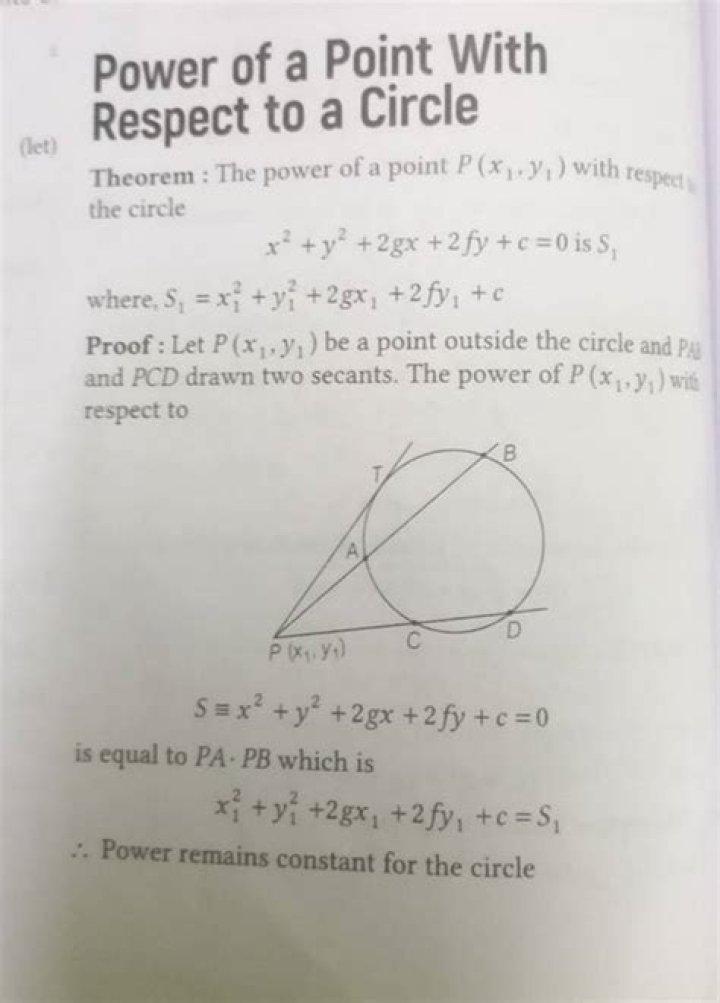
There is a concept of a "power of a point with respect to a circle".
If one has a point which is distance $d$ away from the centre of some circle and that circle has radius $r$ then the power of this point is said to be $d^2-r^2$.
I am unable to find much about the history of this concept except that it originated somewhere in mid $19$th century. Does anybody know why this concept was useful and why it developed?
$\endgroup$ 32 Answers
$\begingroup$The term "power of a point" was first defined by Jakob Steiner in 1826 in a work called "A Few Geometrical Observations." A brief article on this subject can be found here.
Steiner observed that if we consider a circle of radius $r$ and a point $P$ not on the circle, and examine any line which which intersects $P$ and two points on the circle, $A$ and $B$, then we find that $AP\cdot PB$ is constant (that is, the product of the lengths of those two segments is constant) for any $P$ inside or outside the circle. This constant value is $|r^2 - d^2|$ with $d$ being the minimum distance from $P$ to the circle. One way in which this idea is used is in defining the radical axis of two circles: a point is on the radical axis of two circles if it has the same power with respect to both of them.
$\endgroup$ $\begingroup$Note that the definition (and the equality) holds if the line is tangent to the circle.
E.g., the line may intersect $P$ and only one point $T$ of the circle (so it's a tangent line). In that case, $PT^2$ remains constant and equal to $|r^2-d^2|$, where $d$ is the distance from $P$ to $T$, that is, the minimum distance from $P$ to the circle in the intersecting line.
$\endgroup$