Function of at most polynomial growth and its derivative
I consider a function $f:\mathbb{R}^{+} \rightarrow \mathbb{R}$ which is continuous and differentiable.
I know moreover that both $f$ and $f'$ are of at most polynomial growth, i.e. I use the following definition:
The function $g$ is of at most polynomial growth if there exist constants $m$ and $C$ such that$$ |g(x)|\leq C (x^{-m} + x^m) $$for all $x \in \mathbb{R}^{+}$.
My question is:
Is there any relation in the degree of polynomial $m$ occuring in the above equation for $f$ and $f'$ if we know that that both are of at most polynomial growth?
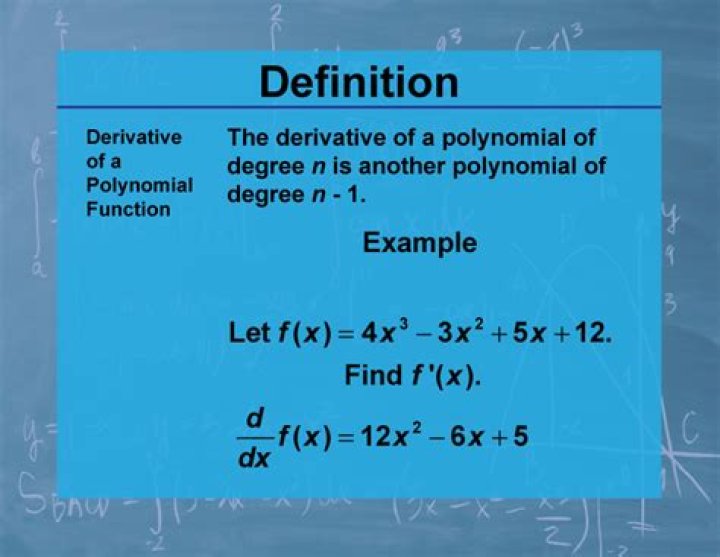
My intuition is that if $f$ is bounded by a polynomial of degree $m$, then $f'$ is bounded by a polynomial of degree $m-1$.
Is this statement true?
$\endgroup$ 41 Answer
$\begingroup$Your statement will only be true when $f(x)$ is a strictly polynomial function. This is not hard to prove using the Power rule of differentiation.
However, it's not true for other non-strictly polynomial functions. We can disprove this extension by taking a simple counterexample. As rightly pointed out by someone in the comments, $f(x) = \sin (e^x)$ is a great counterexample.
Even though $f(x)$ is bounded by polynomial functions, such as $x,x^2,x^3$, etc., $f'(x)=e^x\cdot \cos x$ is obviously not, as the latter has exponential growth, which is always asymptotically greater than any polynomial function.
For further reading, check out the general trends in Big O notation, which is a key tool in algorithm efficiency analysis in computer science.
$\endgroup$ 2