Formal definition of *not* uniformly continuous
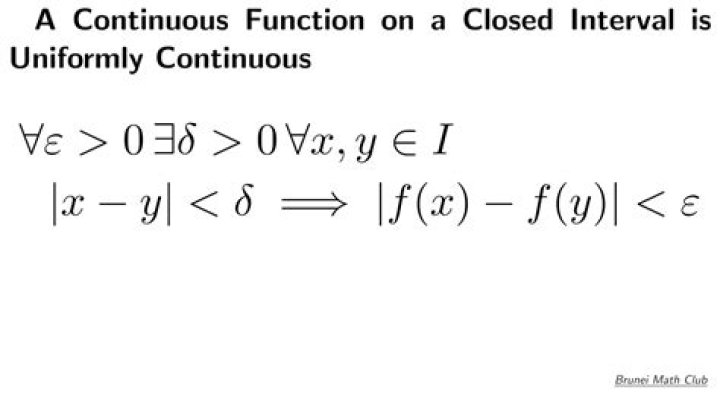
The definition for uniform continuity for a function $f : X \to Y$ is that
for all $\epsilon > 0$, there exists a $\delta > 0$ such that $d_Y(f(p),f(q)) < \epsilon$ for all $p,q \in X$ such that $d_X(p,q) < \delta$.
Mathematically, we can write this definition as
$\forall \epsilon > 0, \exists \delta > 0 \textrm{ such that } d_Y(f(p),f(q) < \epsilon\ \forall p,q \in X \textrm{ for which } d_X(p,q) < \delta.$
I have learned that when negating a statement, one switches the quantifiers, and reverses any equality/inequality statements in the conclusion.
Following these rules, the definition for not uniformly continuous would be
$\exists \epsilon > 0\ \forall \delta > 0 \textrm{ such that } d_Y(f(p),f(q)) \ge \epsilon\ \exists p,q \in X \textrm{ for which } d_X(p,q) < \delta.$
This, however makes little sense as written. I believe that I would be better served writing this as
$\exists p,q \in X \textrm{ such that } \forall \delta > 0 \textrm { for which } d_X(p,q) < \delta, \exists \epsilon > 0 \textrm{ such that } d_Y(f(p),f(q)) \ge \epsilon.$
My question is: does my latter define criteria for which a function is not uniformly continuous? In other words, is this a proper negation of the definition? I believe that it should provide a criteria for a function not being uniformly continuous, but is this the same thing as the wholesale negation of the definition?
$\endgroup$ 11 Answer
$\begingroup$You didn’t really entirely translate the original version into symbols; that would have given you
$$\forall\epsilon>0\exists\delta>0\forall p,q\in X\Big(d_X(p,q)<\delta\to d_Y\big(f(p),f(q)\big)<\epsilon\Big)\;.\tag{1}$$
Because you did the translation incorrectly, your attempts at negating it gave incorrect results.
Negating $(1)$ mechanically, we get
$$\exists\epsilon>0\forall\delta>0\exists p,q\in X\Big(d_X(p,q)<\delta\land d_Y\big(f(p),f(q)\big)\ge\epsilon\Big)\;.$$
In words, there is an $\epsilon>0$ such that no matter how small a $\delta>0$ you choose, there will be points $p,q\in X$ such that $d_X(p,q)<\delta$, but $d_Y\big(f(p),f(q)\big)\ge\epsilon$. An equivalent statement that may be more intuitively comprehensible is that there are an $\epsilon>0$ and sequences $\langle p_n:n\in\Bbb N\rangle$ and $\langle q_n:n\in\Bbb N\rangle$ in $X$ such that $d_X(p_n,q_n)<2^{-n}$ for each $n\in\Bbb N$, but $d_Y\big(f(p_n),f(q_n)\big)\ge\epsilon$ for each $n\in\Bbb N$.
$\endgroup$ 7