Finite additivity follows from countable additivity! [closed]
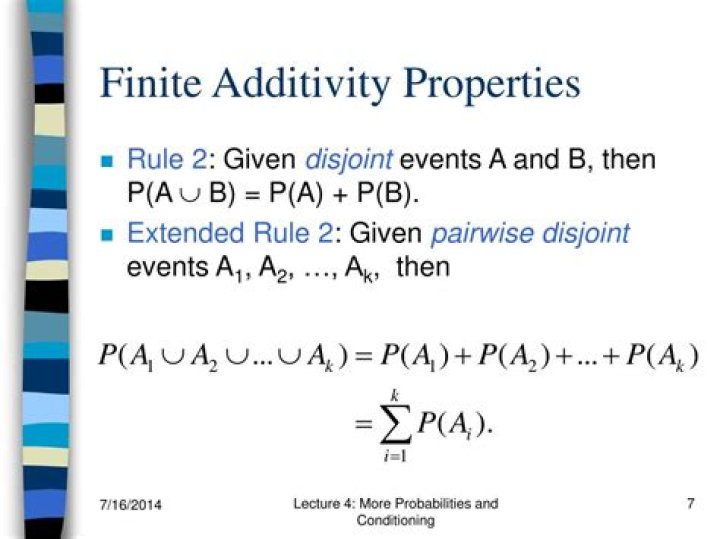
How to prove that finite additivity follows from countable additivity!!?
$\endgroup$ 22 Answers
$\begingroup$I guess this question arises because in the definition of countable additivity it is assumed that there are infinitely many events. But if there are finitely many events, you can just throw in countably many empty events. That is, given $A_1,\ldots,A_n$, define $A_{n+1}=\emptyset$, $A_{n+2}=\emptyset$, and so on, then apply countable additivity.
$\endgroup$ $\begingroup$I assume that you want to show that finite additivity follows from countably infinite additivity. In general, though countable means both finite and countably infinite.
We are given that $\mu(\displaystyle \cup_{i=1}^\infty A_i) = \displaystyle \sum_{i=1}^\infty \mu(A_i)$ whenever $A_i \cap A_j = \emptyset$, $\forall i \neq j$.
So we now want to show $\mu(\displaystyle \cup_{i=1}^n A_i) = \displaystyle \sum_{i=1}^n \mu(A_i)$, $\forall n \in \mathbb{N}$, whenever $A_i \cap A_j = \emptyset$, $\forall i \neq j$.
Now consider $A_{i} = \emptyset$, $\forall i > n$.
By the way we have defined, note that $A_i \cap A_j = \emptyset$, $\forall i \neq j$. (Note: $A \cap \emptyset = \emptyset$, $\forall A$).
By countably infinite additivity, $\mu(\displaystyle \cup_{i=1}^\infty A_i) = \displaystyle \sum_{i=1}^\infty \mu(A_i)$ and note that $\mu(A_i) = 0$, $\forall i > n$.
Also note that $\displaystyle \cup_{i=1}^\infty A_i = \displaystyle \cup_{i=1}^n A_i$, since $A_i = \emptyset$, $\forall i > n$.
Hence, $\mu(\displaystyle \cup_{i=1}^n A_i) = \displaystyle \sum_{i=1}^n \mu(A_i)$ whenever $A_i \cap A_j = \emptyset$, $\forall i \neq j$.
$\endgroup$ 6