Finding the terminal point for $\frac{\pi}{3}$
The problem:
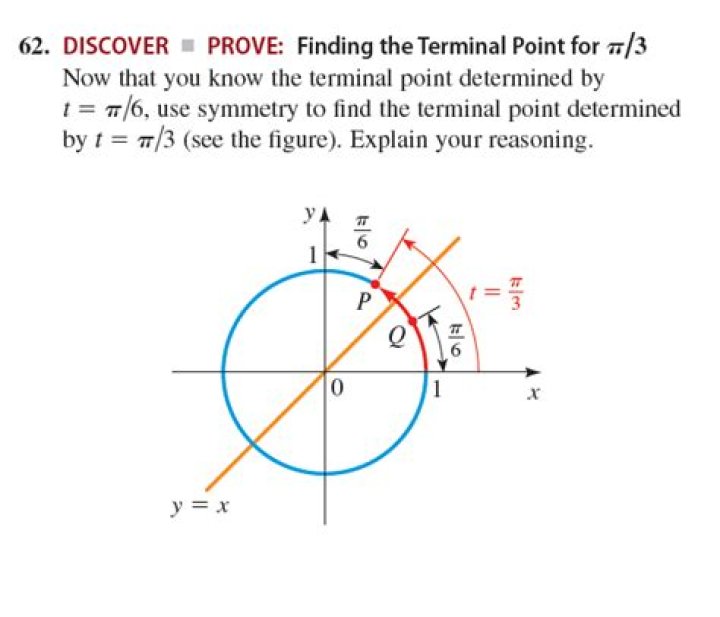
Background: we haven't been taught $\sin$ and $\cos$ functions yet so I refrain from using those. Just by knowing the terminal point determined by $t = \frac{\pi}{3}$ is $\left(\frac{\sqrt 3}{2},\,\frac{1}{2}\right)$and symmetry, how do we solve the question?
I've tried to subtract the $y$-coordinate of the terminal point of $\frac{\pi}{3}$ from that of $(0, 1)$ to get the y-coordinate of the desired point, but it didn't work. I also tried to add up the coordinates of $\frac{\pi}{6}$ with itself and divide it by $2$, which didn't work.
How do I solve this problem?
$\endgroup$2 Answers
$\begingroup$Hint: Consider flipping the entire picture around the line $y = x$ that's drawn in orange. The curved arrow from $(1, 0)$ to $Q$ becomes an arrow from $(0, 1)$ to $P$. And in fact, under this transformation, $(1, 0)$ is sent to $(0, 1)$ and $Q$ is sent to $P$.
$\endgroup$ $\begingroup$Hint :
Let $A=(1,0)$, you can notice that $P$ is the mirror symetric of $A$ relatively to the line $(OQ)$.
The equation of $(OQ)$ is $y=\frac{1}{\sqrt{3}}x$. Since $(PA)$ is orthogonal to $(OQ)$, its equation is $y=-\sqrt{3}x+a, a \in \mathbb{R}$. Let's determine $a$, $A=(1,0)$ is on $(PA)$, so it must verify the equation : $0=-\sqrt{3}+a$, so $a=\sqrt{3}$, so $y=-\sqrt{3}x+\sqrt{3}$.
Let $B$ be the intersection of $(OQ)$ and $(PA)$. We also have $AB=BP$. So let's calculate the coordinates of $B$. Let $B=(u,v)$, we have $v=\frac{1}{\sqrt{3}}u$ and $v=-\sqrt{3}u+\sqrt{3}$, so $v=-3v+\sqrt{3}$, so $v=\frac{\sqrt{3}}{4}$ and $u=\frac{3}{4}$. So $B=(\frac{3}{4},\frac{\sqrt{3}}{4})$.
Finally we know that $AB=PB$. So let $P=(x_P,y_P),A=(x_A,y_A),B=(x_B,y_B)$, we have $x_B-x_A=x_P-x_B$ and $y_B-y_A=y_P-y_B$, so $x_P=\frac{1}{2}$ and $y_P=\frac{\sqrt{3}}{2}$.
$\endgroup$ 4