Finding the Marginal Distribution of Two Continuous Random Variables
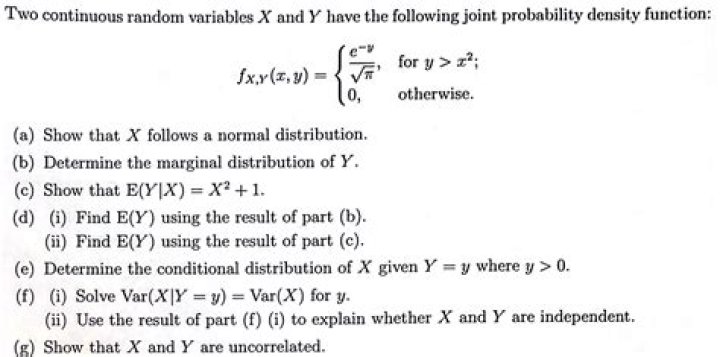
The continuous random variables $X$ and $Y$ have the joint probability density function:
$$f(x, y)= \begin{cases} \dfrac{3}{2}y^2, & \text{ where } 0\leq x \leq 2 \text{ and } 0 \leq y \leq 1 \\[2ex] 0, & \text{ otherwise} \\ \end{cases} $$
I am asked to find the marginal distributions of $X$ and $Y$, and show that $X$ and $Y$ are independent.
I know the marginal distribution to be the probability distribution of a subset of values, does that mean the marginal distribution can be obtained by calculating the probability distribution of the piecewise function in locations where $f(x, y)$ does not equal zero?
$\endgroup$3 Answers
$\begingroup$I know the marginal distribution to be the probability distribution of a subset of values,
Yes. In this case, the subsets of $\{X, Y\}$ we're interested in are $\{X\}$ and $\{Y\}$.
You have been given the joint density function, $f_{X,Y}(x,y)$, and the support for this function, $0\leq x\leq 2, 0\leq y\leq 1$. To obtain the marginal density functions, you integrate over the support for the unwanted variable.
$$\begin{align} f_X(x) & = \int_{0}^1 f_{X,Y}(x,\color{blue}{y})\operatorname d \color{blue}{y} & : \big[0\leq x\leq 2\big] \\[1ex] & = \tfrac 3 2 \int_0^1 \color{blue}y^2 \operatorname d \color{blue}y \\[1ex] & = \tfrac 1 3 \\[2ex] f_Y(y) & = \int_0^2 f_{X,Y}(\color{blue}{x}, y)\operatorname d \color{blue}{x} & : \big[0\leq y\leq 1\big] \\[1ex] & = \tfrac 3 2 y^2 \int_0^2 \operatorname d \color{blue}x \\[1ex] & = 3 y^2 \end{align}$$
$\endgroup$ 3 $\begingroup$Hints:
You integrate the joint density $f(x,y)$ with respect to $y$ to get the marginal of $X$ i.e. $f_X(x)$. Integration must be done with proper limits.
Similarly you integrate the joint density $f(x,y)$ with respect to $x$ to get the marginal of $y$ i.e. $f_Y(y)$. Here again note the proper limits of integration.
Now to show that $X$ and $Y$ are independent, show that $f_X(x)f_Y(y)=f(x,y)$. Another way would be to observe that the supports of $X$ and $Y$ are independent rectangles, and the joint p.d.f. is of the form $g(x)h(y)$ where $g(x)$ involves no $y$ and $h(y)$ involves no $x$. This is a condition, which, if you didn't already know, tells you that $X$ and $Y$ are independent.
$\endgroup$ $\begingroup$Hint: $$\begin{align*} f_X(x) &= \int\limits_{-\infty}^{\infty}f_{X,Y}(x,y)\text{ d}y \sim \int_{\text{outside of }[0, 2]}0+\int\limits_{0}^{2}\dfrac{3}{2}y^2\text{ d}y = \int\limits_{0}^{2}\dfrac{3}{2}y^2\text{ d}y\\ f_Y(y) &= \int\limits_{-\infty}^{\infty}f_{X,Y}(x,y)\text{ d}x \sim \int_{\text{outside of }[0, 1]}0+\int\limits_{0}^{1}\dfrac{3}{2}y^2\text{ d}x = \int\limits_{0}^{1}\dfrac{3}{2}y^2\text{ d}x \end{align*}$$
$\endgroup$ 1