Finding the Magnitude of a Vector in the Opposite Direction
I am trying to find the answer to a question which seems a little unusual. I have found plenty of questions about vectors in opposite directions, but never in this format:
Given v is a vector of magnitude 4 state a vector of magnitude 36 in the opposite direction of v.
Any help would be greatly appreciated.
$\endgroup$ 31 Answer
$\begingroup$Here are a few hints to help you.
What is the unit vector in the direction of $\vec v$? (you have the right idea, dividing by the magnitude)
What is the unit vector in the opposite direction? (you have the right idea, multiplying by negative one)
Now finally, what is a vector in that new direction with a magnitude of $36$? (what do you do with a unit vector to scale it to a certain magnitude? It's all in the name - a (positive) scalar multiple scales a vector without changing its direction).
EDIT (responding to the asker's comments, and giving the solution, as you've clearly thought about the problem):
"...find the direction of v by dividing 4 by the square root of 4 squared."
Actually, you start by dividing the vector $\vec v$ by its magnitude. The magnitude is $4$. So you end up with $\frac 14 \vec v$. This is the unit vector in the direction of $\vec v$.
Remember that dividing a vector by its magnitude gives the unit vector in the original vector's direction. You seem to have the right notion talking about the vector's direction, but please use the correct math term: the unit vector.
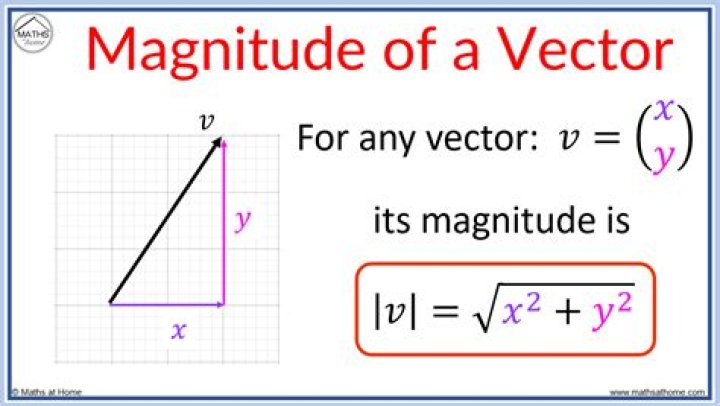
(Don't confuse yourself with this "square" and "square root" stuff - that's only important when you're trying to find the magnitude of a vector given its orthogonal components (the $x$ and $y$ components in two dimensions). Here, the magnitude is already given).
The next step is to reverse it by multiplying by $-1$. This doesn't change the magnitude but simply reverses the vector, so you get a unit vector facing in the exact opposite direction. The final step is to multiply by $36$, which scales the new vector to the required length.
You can (as you wrote) combine both steps by multiplying immediately by $-36$. So you end up with $(-36)(\frac 14 \vec v) = -9 \vec v$, which is the required solution.
$\endgroup$ 2