Finding the local maximum from a definite integral
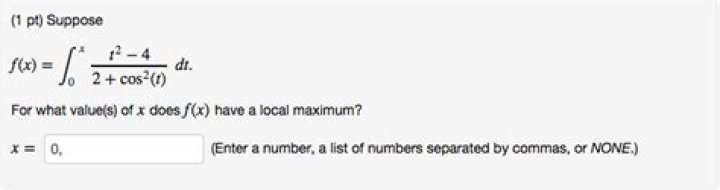
For this, is the First Derivative Test being used? If that's the case then wouldn't the equation be: $$(x^2 - 4) / (2 + \cos^2 (x))$$ I'm just not sure how to go about starting this problem.
$\endgroup$ 13 Answers
$\begingroup$You did good, be confident.
Using the fundamental theorem of calculus, $f'(x)=(x^2-4)/(2+\cos^2(x))$, and we are interested in points where $f'(x)=0$, and that would be when $x^2-4=0$ a.e $x=\pm 2$.
In order to check that it is indeed a local maximum (and not minimum) you could either use the second-deriviative test, or look close to $\pm 2$ and see for yourself.
I like the second-derviative so lets do it - $f''(x)=(2x(2+\cos^2(x))+2\cos(x)\sin(x))/(2+\cos^2(x))^2$.
we have $f''(2)>0$ and $f''(-2)<0$, so the only maxima is $x=-2$.
$\endgroup$ 1 $\begingroup$You have $f'(x) = (x^2-4)/(2+\cos^2(x))$
The denominator, $2+\cos^2 x$, is strictly positive since it's always $\ge 2$.
Therefore $f$ increases where the numerator is positive and decreases where the numerator is negative.
The numerator is $x^2-4=(x-2)(x+2)$ and that is positive when $x>2$ and when $x<-2$, and is negative when $-2<x<2$. So $f$ increases on the interval $(-\infty,-2]$, decreases on $[-2,2]$, and increases on $[2,\infty)$. Thus there is a local maximum at $x=-2$ and there is a local minimum at $x=2$.
$\endgroup$ $\begingroup$the derivative of integral give us ( see ) $$f'(x)=\frac{x^2-4}{2+\cos^2 x}$$ let $f'(x)=0$ we will get the $$x^2-4=0$$ $$x=\pm 2$$
$\endgroup$ 1