Finding the determinant of cofactor matrix
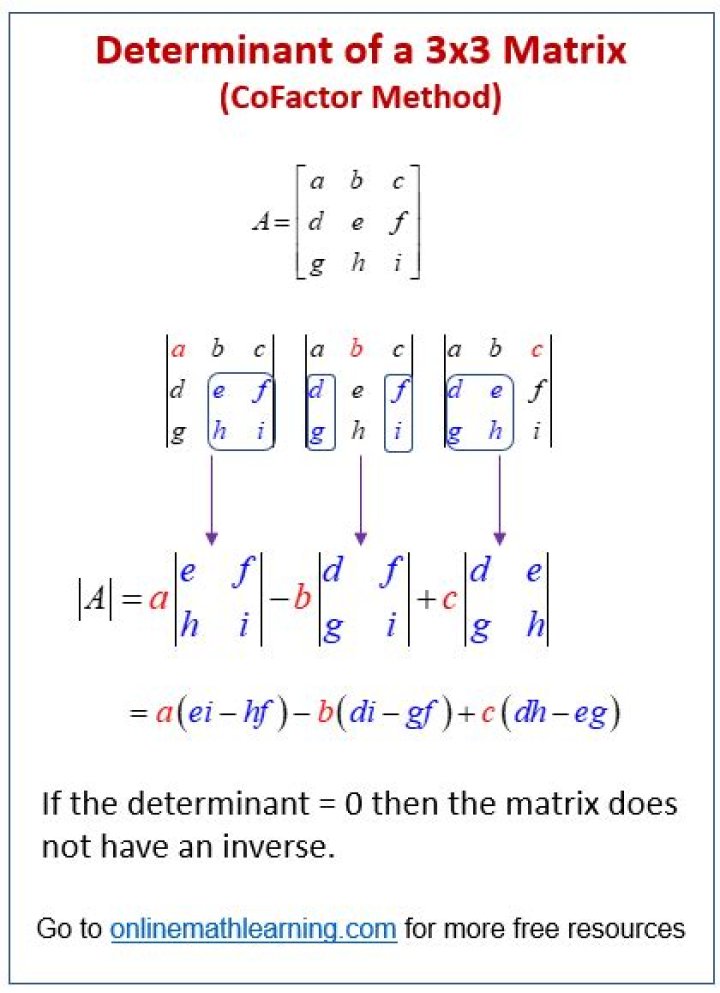
Let
\begin{align} \Delta &= \begin{vmatrix} x_1 & x_2 & x_3 \\ x_4 & x_5 & x_6 \\ x_7 & x_8 & x_9 \\ \notag \end{vmatrix} \notag \end{align}
and let $C_i$ represent the cofactor of $x_i$.
Find
\begin{align} \begin{vmatrix} C_1 & C_2 & C_3 \\ C_4 & C_5 & C_6 \\ C_7 & C_8 & C_9 \\ \notag \end{vmatrix} \notag \end{align}
in terms of $\Delta$.
Generalize that if $\Delta$ represents the determinant of a $n\times n$ matrix, then the determinant of the cofactor matrix is $\Delta^{n-1}.$
Looking at the generalization, I was tempted to multiply both the determinants.
\begin{align} \begin{vmatrix} x_1 & x_2 & x_3 \\ x_4 & x_5 & x_6 \\ x_7 & x_8 & x_9 \\ \notag \end{vmatrix} \times \begin{vmatrix} C_1 & C_2 & C_3 \\ C_4 & C_5 & C_6 \\ C_7 & C_8 & C_9 \\ \notag \end{vmatrix} \notag = \begin{vmatrix} x_1.C_1+x_2.C_2+x_3.C_3 & x_1.C_4+x_2.C_5+x_3.C_6 & x_1.C_7+x_2.C_8+x_3.C_9 \\ x_4.C_1+x_5.C_2+x_6.C_3 & x_4.C_4+x_5.C_5+x_6.C_6 & x_4.C_7+x_5.C_8+x_6.C_9 \\ x_7.C_1+x_8.C_2+x_9.C_3 & x_7.C_4+x_8.C_5+x_9.C_6 & x_7.C_7+x_8.C_8+x_9.C_9 \\ \notag \end{vmatrix} \end{align}
\begin{align} \implies \Delta \times \begin{vmatrix} C_1 & C_2 & C_3 \\ C_4 & C_5 & C_6 \\ C_7 & C_8 & C_9 \\ \notag \end{vmatrix} \notag = \begin{vmatrix} \Delta & x_1.C_4+x_2.C_5+x_3.C_6 & x_1.C_7+x_2.C_8+x_3.C_9 \\ x_4.C_1+x_5.C_2+x_6.C_3 & \Delta & x_4.C_7+x_5.C_8+x_6.C_9 \\ x_7.C_1+x_8.C_2+x_9.C_3 & x_7.C_4+x_8.C_5+x_9.C_6 & \Delta \\ \notag \end{vmatrix} \end{align}
Can someone help me figure out the next step?(This huge determinant must be equal to $\Delta^3$)
$\endgroup$ 13 Answers
$\begingroup$Hint : For every square matrix $A$ of size $n \geq 2$, denote by $C(A)$ the matrix of its cofactor. Then $A$ is invertible iff $C(A)$ is invertible, and you have the relation$$A \times (C(A))^T = \det(A) I_n$$
$\endgroup$ 2 $\begingroup$Hint:
first of all prove for yourself that $$x_1C_4+x_2C_5+x_3C_6=0$$.
Symmetrically it is easy to see that all the elements other than the ones in diagnal($i=j$) are zero.Thus we have \begin{vmatrix} \Delta & 0 & 0\\ 0 & \Delta & 0\\ 0 & 0 & \Delta \\ \notag \end{vmatrix} which comes out to be ${\Delta}^3$
$\endgroup$ $\begingroup$The matrix which you have posted is also known as the 'Cofactor Matrix'. The transpose of this cofactor matrix is more commonly used, and is known as the adjoint or adjugate of the matrix, denoted by $adj(A)$.
It is a well known (and easily proven) property for an square matrix of order $n$ that$$ A.adj(A) = |A|I_n $$where $I_n$ is the identity matrix of order n and $|A|$ represents the determinant of the matrix A, $\Delta$. From here, it follows that $|A|.|adj(A)|= |A|^n$ and hence, $|adj(A)| = |A|^{n-1}$.
We also know that the determinant of a matrix is the same as that of it's transpose (since we are only interchanging the rows and columns). Hence the determinant of the cofactor matrix should also be $|A|^{n-1}$.
$\endgroup$ 1