Finding the area of a semicircle knowing a chord and other small semicircle tangent to it.
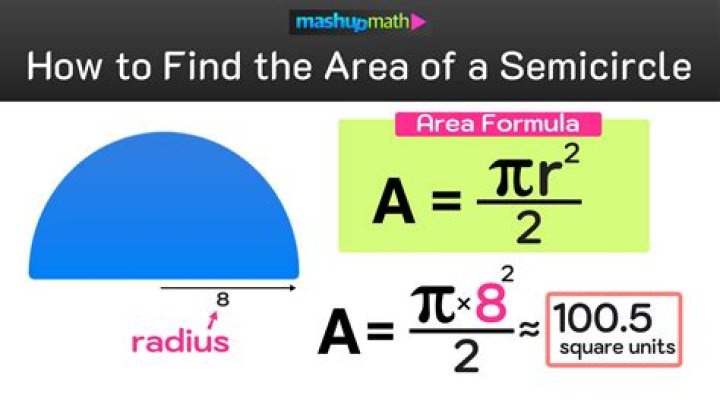
In a semicircle of diameter $CD$ there's a chord $AB$ of length 7, and it's parallel to the diameter. There's also a small semicircle that is tangent to $AB$ and its diameter is a segment in $CD$ . Find the area of the semicircle without the small semicircle.
I'm pretty curious about this problem, i've tried many things, like drawing triangles that are similar and also rectangles, so i tries with pithagorean theorem but i got nothing. I'd really like to know how to solve it, thanks.
$\endgroup$ 22 Answers
$\begingroup$Place the small semicircle center on the center of the big semicircle, for simplicity. This won't change the area you are looking for.
Let us call $r$, $R$ and $d$ the radius of the small semicircle, the radius of the big semicircle and half the chord, respectively.
Using your notation, join $A$ with the center $O$ of the semicircles: that is of course a radius of the big semicircle. If you erect a perpendicular from the center to the chord, intersecting at $H$, you draw a right triangle $AOH$, whose hypotenuse is the radius $R$ and whose cathetuses are $r$ and $d$.
The area you are looking for is: $$\frac{\pi}{2}R^2 - \frac{\pi}{2} r^2$$
Though, by Pythagorean Theorem, you have that $R^2 = r^2 + d^2$. By plugging this into the preivous expression, you find:
$$A= \frac{\pi}{2}(r^2 + d^2) - \frac{\pi}{2}r^2 = \frac{\pi}{2}d^2$$
Now you can calculate that area, since you have the length of the chord and, thus, $d=7/2$. As a result,
$$A = \frac{49 \pi}{8}$$
Since we're told nothing about the radius of the small semicircle, let's assume its radius is zero, and hence its area is also zero. Then $AB$ is the diameter of the large semicircle and the radius is $7/2$.
The area of a semicircle is given by $\frac{\pi}{2}r^2$, so the area is $\frac{49\pi}{8}$.
$\endgroup$ 1