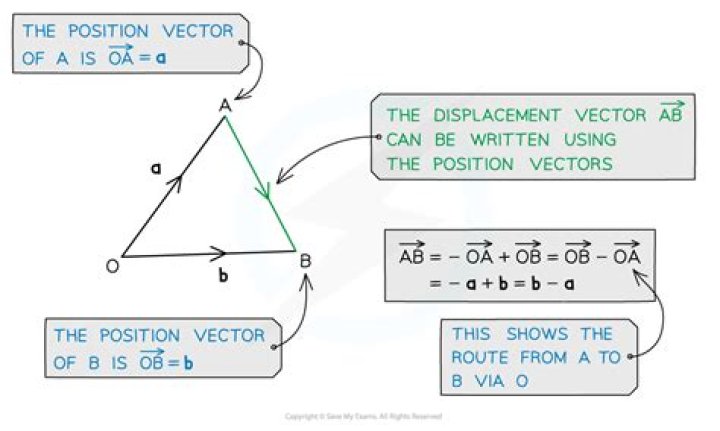
Finding the angle between two vectors, vectors have both a position vector and a direction vector
I'm trying to find the angle between the vectors
\begin{align} r_{1} &: 2j -4k + \lambda (i+k) \\ r_{2} &: 7i + k + \mu (2i-j+k) \end{align}
The equation for the angle between them is $$\cos(\theta)= \frac{r_{1} \cdot r_{2}}{\lvert r_{1} \rvert \lvert r_{2} \rvert }$$
What throws me off is that the vectors have both a position vector and a direction vector, can I use either?
Edit: fixed huge mistake with the D.V. of the 2nd line
$\endgroup$ 22 Answers
$\begingroup$I do not view either $r_1$ or $r_2$ as a "vector." Instead, each of them is a line in a three-dimensional space. In order to describe each line, we have arbitrarily chosen one point on each line (identified by the position vector of that point) and parameterized the rest of the line by a vector parallel to the line.
The choice of point for the position vector really is arbitrary: we could just as well write $$ r_1{:\ } i + 2j - 3k + \xi(i+k) $$ and it would describe exactly the same line as in the question.
We can also substitute a scalar multiple of the direction vector: $$ r_1{:\ } i + 2j - 3k + \phi(2i+2k) $$ is still the same line.
In fact you can get the same line from many different possible position vectors, but you must always use a direction vector that is some multiple of the same direction vector. The different choices of direction vector will always give the same answer from the angle formula (except that there are really usually two angles between two lines, an obtuse angle and an acute angle, and if we multiply one of the directions by a negative number we'll change which of those angles the formula gives us). The different choices of position vector will (except in special cases) give us many different answers.
So if you want the angle between two lines, use the angle between their direction vectors. Intuitively, it is the direction of a line that determines the angle with another line, not the position of the line.
$\endgroup$ 5 $\begingroup$at first i would write both vectors in the form$r_1$:$$\lambda\vec{i}+2\vec{j}+\vec{k}(\lambda-4)$$$r_2$:$$\vec{i}(7+2\mu)+\vec{j}(-\mu)+\vec{k}(1+\mu)$$if These vectors reprent line then we gat$$\cos(\theta)=\frac{2+1}{\sqrt{2}\sqrt{6}}$$and we get $$\theta=30^{\circ}$$
$\endgroup$ 9