Finding the altitude of the cone with minimum volume circumscribed about a hemisphere of radius R
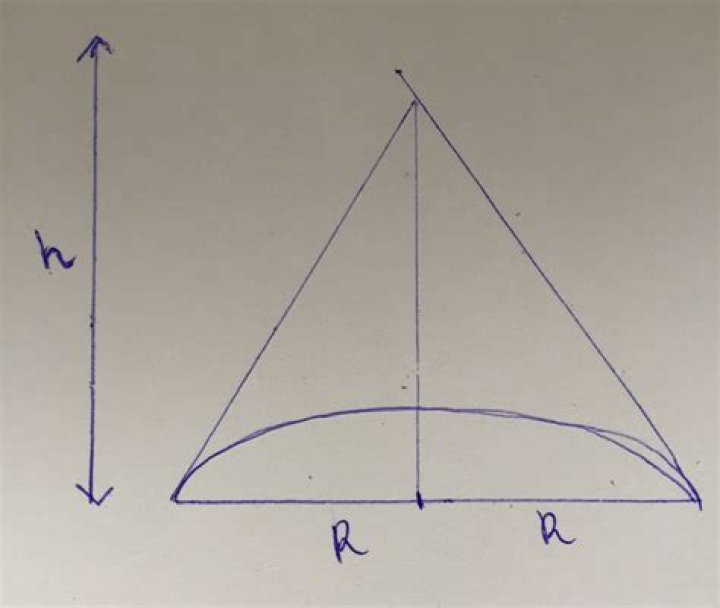
I have tried considering a plane parallel to that of the base of the hemisphere at a distance $R$ to work with some similar triangles, but all I could find is that the radius of the base of the smaller cone is $r = \frac{R(h-R)}{h}$ where $h$ is the altitude of the big cone. I'm having trouble finding a relation between $R$ and $h$. Any help would be appreciated.
For those wondering, this is Problem 50 from Chapter V by Differential and Integral Calculus by N. Piskunov.
3 Answers
$\begingroup$Hints:
- Your diagram slightly obscures the fact there are two radii. Try this one instead:
Find $r$ in terms of $h$ and $R$, using similar triangles and Pythagoras: I think you get $\dfrac{hR}{\sqrt{h^2-R^2}}$ rather than $\dfrac{R(h-R)}{h}$
Find the volume of the cone in terms of $h$ and $r$, and then by substitution in terms of $h$ and $R$
Find the $h$ which minimises this volume while keeping $R$ constant, for example by differentiation - you should get $R \sqrt 3$
See the diagram. Now can you find $OH$ and $OA$ in terms of radius of the sphere $R$ and angle $x$ where $OH$ is the height of the cone, $OA$ is radius of the base of the cone and $OT = R$ is the radius of the sphere. $OT$ is perpendicular to $AH$.
Then you need to find angle $x$ for which the volume is minimum and that boils down to maximizing $\sin^2x \cos x$.
Can you take it from here?
$\endgroup$ $\begingroup$Minimize
$$ volume \; V = \frac{\pi r^2 h}{3} \tag1$$subject to constraint of right triangle sides ( not directly given) connecting the constant $R$
$$\frac{1}{R^2}=\frac{1}{h^2}+\frac{1}{r^2} \tag 2$$
By plugging in (2) and setting derivative to zero as usual and simplifying we get
$$ \frac{h}{r}= \sqrt 2\;; \frac{h}{R} =\sqrt 3 .\tag 3$$
$\endgroup$