Finding Maxima and Minima Values when the second derivative is a constant
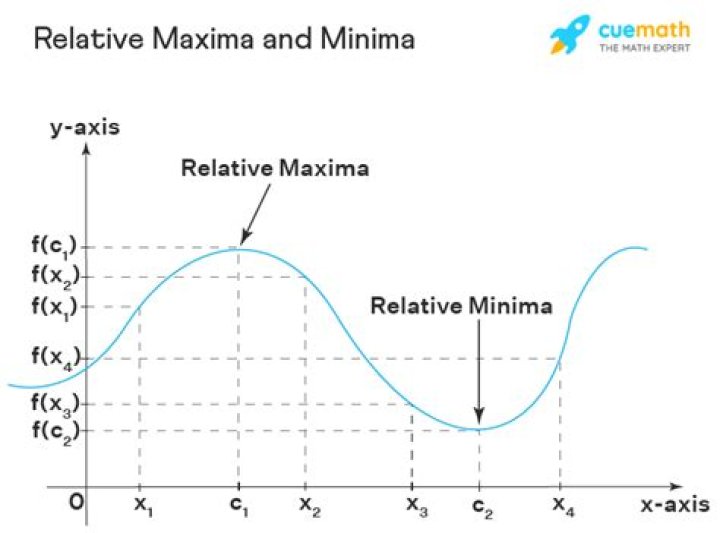
I am given the following quadratic over the closed interval $[0,3]$ $f(x) = x-x^2$
I'm asked to find the value inside that interval that is the largest value and smallest value.
I easily see that if I take the first derivative $f`(x) = 1-2x$ and setting that $=0$ gives $x=5$. I can plug this value into the $f(x)$ and see that this gives the largest value (which is $1/4$).
My question is how do I interpret the fact that the second derivative is $-2$ over the entire closed domain? Seems like since the second derivative is a negative constant, then the function would be at a maximum over the ENTIRE domain, which it clearly is not.
So, I'm confused over the interpretation of the second derivative.
$\endgroup$ 13 Answers
$\begingroup$The second derivative being negative means that in the interval the function is concave down, so if there is a stationary point in this interval ( as is the case), this point is a maximum.
I other words, the sign of the second derivative indicate the concavity of the function and the concavity can be ''up'' or ''down'' also on points that are not minimum or maximum, but if a point is a stationary point, than a positive (up) concavity implies that the point is a minimum, and a negative (down) concavity means that the point is a maximum.
$\endgroup$ 3 $\begingroup$The second derivative at a specific point is the rate of change of the derivative at that point. You can interpret it as the rate of change of the slope of the tangent line.
Thus, a negative second derivative means that the slope is instantaneously decreasing. This translates to the curve being concave down, as Emilio Novati noted in his answer.
In your case, the second derivative is constant and negative, meaning the rate of change of the slope over your interval is constant. Note that this by itself does not tell you where any maxima occur, it simply tells you that the curve is concave down over the whole interval. Once you have found the points where the derivative is zero, however you can use the fact that the curve is concave down to determine that the point is indeed a maximum.
Note that in general, when you are given a closed interval and asked to find the maxima and minima over said interval, you also need to check the value of the function at both of the endpoints, because though these points may not have a derivative of zero, there could be a maximum or minimum there.
$\endgroup$ $\begingroup$The second derivative tells us the concavity of the function. When it is positive, the function is concave up; when it is negative, the function is concave down. It also tells us the rate at which the first derivative is changing. When the second derivative is positive, the first derivative is increasing; when the second derivative is negative, the first derivative is decreasing. Since we are interested in finding the extrema of the function on the interval, we are interested in what the second derivative is telling us about the first derivative.
We are given the function $f(x) = x - x^2$ defined on the interval $[0, 3]$. We wish to find the relative and absolute extrema. As you found, \begin{align*} f'(x) & = 1 - 2x\\ f''(x) & = -2 \end{align*} The function has a critical point (or stationary point) where the first derivative is equal to zero. This occurs at $x = 1/2$.
When the first derivative is positive in an interval, the function is increasing. When the first derivative is negative in an interval, the function is decreasing.
In this problem, the first derivative is a linear function with a slope of $-2$. It decreases from $1$ at $x = 0$ (where only the right-sided derivative exists) to $-5$ at $x = 3$ (where only the left-sided derivative exists), changing signs at $x = 1/2$. Thus, the derivative is positive on the interval $[0, 1/2)$, zero at $x = 1/2$, and negative on the interval $(1/2, 3]$. Since the function is increasing to the left of $x = 1/2$, decreasing to the right of $x = 1/2$, and defined at $x = 1/2$, it has a relative maximum at $x = 1/2$.
We have just applied the First Derivative Test, which states that if $f$ is a continuous function on the closed interval $[a, b]$ and $f'(x)$ exists everywhere in the open interval $(a, b)$ except possibly at $x = c$, then
(a) if $f'(x) > 0$ for each $x < c$ and $f'(x) < 0$ for each $x > c$, then $f$ has a relative maximum at $c$;
(b) if $f'(x) < 0$ for each $x < c$ and $f'(x) > 0$ for each $x > c$, then $f$ has a relative minimum at $c$.
As you noticed, the second derivative is a negative constant. This means that the graph of the function is concave down throughout the interval and that the first derivative is decreasing at a constant rate. Since the second derivative is negative in an interval containing a point where the first derivative is zero, the first derivative changes from positive to negative at the critical point. By the First Derivative Test, this means the function has a relative maximum at that point.
We have just applied the Second Derivative Test, which states that if $f$ has a critical point $c$ and $f''$ exists in an open interval $(a, b)$ and
(a) if $f''$ is negative in $(a, b)$, then $f$ has a relative maximum at $c$;
(b) if $f''$ is positive in $(a, b)$, then $f$ has a relative minimum at $c$.
Since the function has only one critical point, $x = 1/2$ is the only relative extremum (relative maximum or relative minimum). To test whether the absolute maximum occurs at $x = 1/2$, you have to compare the value of $f(x)$ at $x = 1/2$ with the values of $f(x)$ at the endpoints of the interval. Since the function does not have a relative minimum, the absolute minimum must occur at one of the endpoints of the interval.
$\endgroup$