Finding basis of kernel of a linear transformation
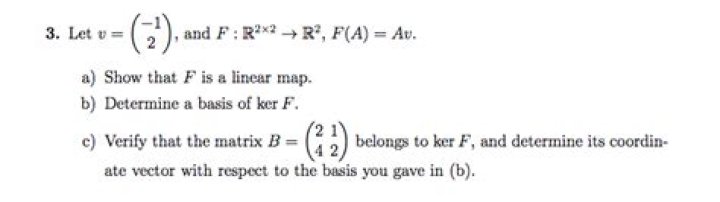
I was trying to do my Linear algebra HW, and I was stuck on a question. The question is the one shown below:
I was able to do part (a), but I am having trouble in doing part (b) and (c). For part (b), I assumed an arbitrary matrix $ \ A= \left[ {\begin{array}{cc} a & b \\ c & d \\ \end{array} } \right] $, and applied the linear transformation F(A), which gave me $ \ F(A)= \left[ {\begin{array}{cc} -a+2 b \\ -c+2d \\ \end{array} } \right]$. In order for it be a kernel, it must equal the zero vector, thus a=2b, c=2d. Thus $ \ A= \left[ {\begin{array}{cc} 2b & b \\ 2d & d \\ \end{array} } \right]$
But does that mean that the ker F= {$ \ \left[ {\begin{array}{cc} 2 \\ 0 \\ \end{array} } \right]$, $ \ \left[ {\begin{array}{cc} 0 \\ 1 \\ \end{array} } \right]$} as these will span the whole of $R^2$ and this is what I get after separating b and d vectors. Am I doing something wrong here.
Also, how to find a coordinate vector [B] with respect to the basis that I got (or will get if I am wrong). Any help will be greatly appreciated.
$\endgroup$ 32 Answers
$\begingroup$$\text{ker}F$ is a space of matrices here, so you need to find a basis consisting of matrices for this subspace. First letting $b=1$ and $d=0$, then the opposite, we obtain the basis $$\left\{ \left[ {\begin{array}{cc} 2 & 1\\ 0 & 0\\ \end{array} } \right], \left[ {\begin{array}{cc} 0 & 0\\ 2 & 1\\ \end{array} } \right]\right\}$$
The coordinate vector of the matrix in the question is the vector $(a,b)$ such that $\left[ {\begin{array}{cc} 2 & 1\\ 4 & 2\\ \end{array} } \right]=a\left[ {\begin{array}{cc} 2 & 1\\ 0 & 0\\ \end{array} } \right]+b\left[ {\begin{array}{cc} 0 & 0\\ 2 & 1\\ \end{array} } \right]$.
$\endgroup$ 3 $\begingroup$You should have $Av=0$ and if $A$ is equal the following matrix:
$$\begin{bmatrix} a & b \\ c & d \\ \end{bmatrix} $$
Then $a=2b$ and $ c=2d$. Now $A$ is the following one:
$$\begin{bmatrix} 2b & b \\ 2d & d \\ \end{bmatrix} $$
and its basis is:
$$\left\{\begin{bmatrix} 2 & 1 \\ 0 & 0 \\ \end{bmatrix} \begin{bmatrix} 0 & 0 \\ 2 & 1 \\ \end{bmatrix}\right\}$$
$\endgroup$