Find the Vector Equation of a line perpendicular to the plane.
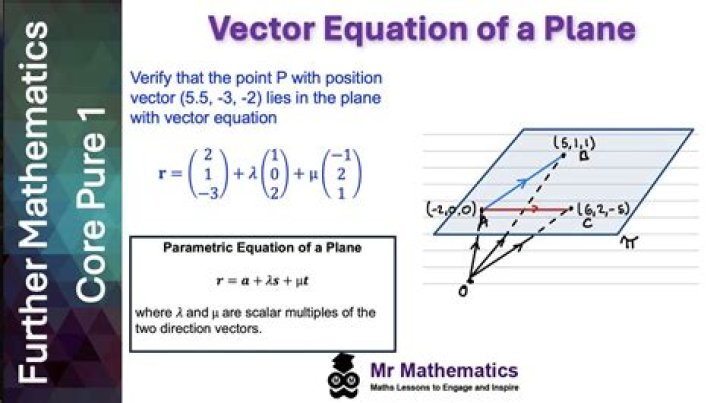
Question: Find the vector equation $r(t)$ for the line through the point $P = (-1, -5, 2)$ that is perpendicular to the plane $1 x - 5 y + 1 z = 1$. Use $t$ as your variable, $t = 0$ should correspond to $P$, and the velocity vector of the line should be the same as the standard normal vector of the plane.
This one is really giving me a hard time. I know that to find the plane perpendicular to the line I can use the vector n between two points on the line and and the plane. I cannot wrap my mind around how to reverse this process, particularly because the plane is equal to 1 and not zero.
Any help would be greatly appreciated.
$\endgroup$2 Answers
$\begingroup$The vector equation for any line is
$$r(t) = \text{point you want it to pass through} + \text{parameter} \cdot \text{velocity vector}.$$
You want it to pass through the point $P = (-1,-5,2)$ and uses the parameter $t$, so we write
$$r(t) = (-1,-5,2) + t \cdot \text{velocity vector}.$$
As it asked to set the velocity vector as the normal vector to the plane, and that is $N = (1,-5,1)$, we get
$$r(t) = (-1,-5,2) + t (1,5,1).$$
The parameter could have been anything else. We could have chosen $2t, t/7$ or $4t-3$. What difference does it make?
In the first two cases we are changing the speed at which the point walks the line. With $2t$ it walks twice as faster, with $t/7$ it walks $1/7$ slower.
The case $(4t-3)$ changes both speed and at what time you pass through the desired point. With $(4t-3)$ you'll pass through point $P$ at the time $t=3/4$. Using the parameter $t$ ensures that at time $t=0$, so to speak, you begin at point $(-1,-5,2)$.
$\endgroup$ 1 $\begingroup$In general, the normal vector of the plane $a\cdot x+b\cdot y+c\cdot z+d=0$ is $(a,b,c).$
Hence, the normal vector of the plane $1\cdot x-5\cdot y+1\cdot z-1=0$ is $(1,-5,1).$
Hence, the line can be represented by $t$ as $$\frac{x-(-1)}{1}=\frac{y-(-5)}{-5}=\frac{z-2}{1}=t.$$ Thus, $$r(t)=\left(t-1, -5t-5, t+2\right).$$
$\endgroup$ 4